Ink, Watercolour, and the Ghosts in the Margins: Francesca Baerald Maps the Imaginary
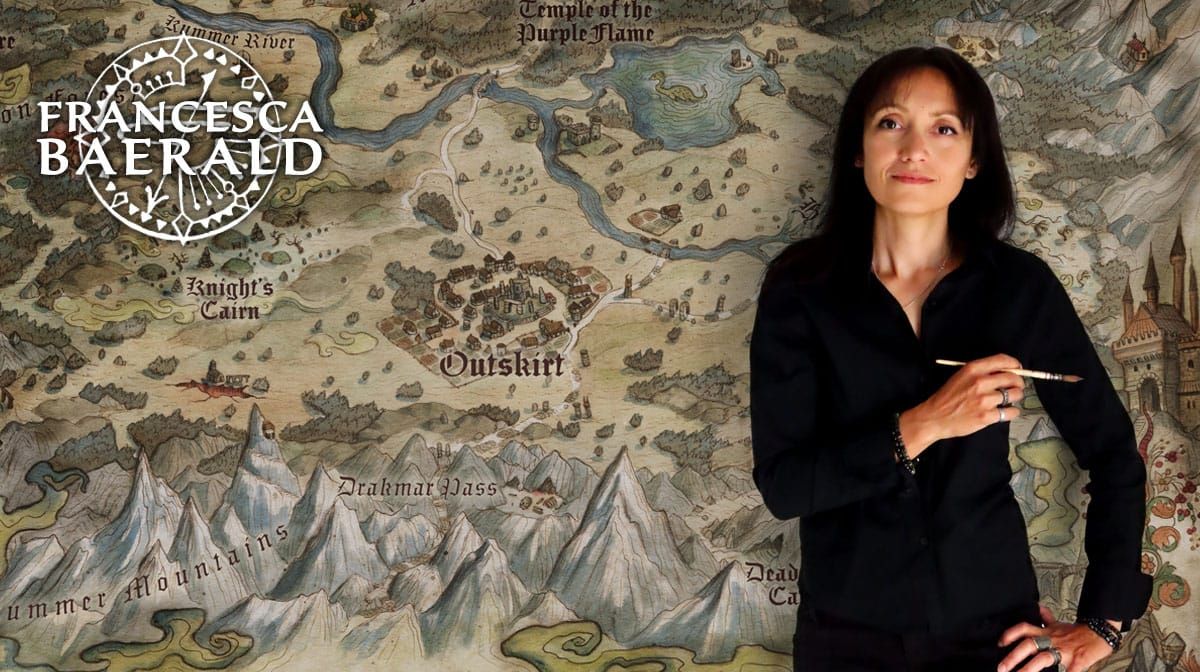
Most of us learned to read a fantasy map the same way: find the town you're in, find the town you're heading to, count the mountains in between. Francesca Baerald would like you to stop doing that. For her, a map is not an instrument for measuring distance - it's a doorway. Painted by hand in watercolour and ink on cotton paper, her maps aim to pull you across the threshold into a world that already feels lived-in, remembered, and slightly haunted before you've even placed a single miniature on the table.
If you've spent time inside Conan's Hyborian Age, wandered Thedas in Dragon Age, puzzled over Planescape's Outlands, or explored the lands of Diablo, Legend of the Five Rings, or Octopath Traveler, there's a good chance you've travelled on her brushstrokes.
Across 13+ years she's earned a reputation for maps that honour their source worlds while quietly smuggling in something extra: hidden monsters in the margins, two figures arguing on a lonely road, a tower that shouldn't be there: little secrets waiting for the observant eye, in the spirit of medieval scribes decorating a manuscript.
We talked with her about the tension every cartographer of imaginary places has to manage: informing, setting a mood, and telling a story, often all at once. She's refreshingly honest about where a mapmaker's creative freedom ends and someone else's universe begins, why empty space can say more than a labelled city, and how she quietly reset her whole approach to learn sumi-e painting for one project.
We also caught her at a turning point. With Unbound, her first artbook, Francesca is stepping out from behind other people's art briefs to draw worlds that are entirely her own a prospect she describes as equal parts liberating and terrifying.
A map can inform, establish a mood, and tell a story at the same time. How do you determine the hierarchy of those three functions for a particular project?
When painting a map, my first aim is to create an artwork that feels like a portal to another world. I want players and readers to feel an immediate connection with the setting’s lore and really get drawn into these new lands ready to be explored. So, establishing the mood is very important for me.
I also believe this way a map becomes something more than an instrument, it can transform into an illustration that you can admire and experience for years to come, even once you’ve finished travelling or exploring these fantastical lands. A beacon that lets you journey in your memories of past adventures.
Evidently, when creating the typical RPG map, there are some rules you cannot subvert; important information must be clearly depicted and locations must be placed in the correct spots. But as a player and a reader I always prefer a map that helps me feel inside a new world, rather than a mere distance tracker between locations.
Telling the story is probably the most fun part for me. Once I’ve studied the setting and got into the lore, then I like to draw characters, important elements and symbolic items in my decorated borders. I also love to hide small easter-eggs directly inside the map; and it fills me with joy when someone get in touch telling me that they have noticed these little hidden features!
When you receive a description of a fictional world, how do you identify the places that truly matter to its inhabitants, even if the text does not state their importance explicitly?
This is something I like to discuss with the creator of the fictional world, because there are many elements that it is really important to take in consideration. I like to give space to my intuition and experience, adding things that are not explicitly stated in the art brief, but I also have to give priority to the features that the art director considers vital and iconic to the setting.
Since all of my maps are painted with traditional media (mainly watercolours and ink on cotton paper), the first thing I try to get information on is the map size for the project. As you may imagine, when you are drawing a map that will be printed inside a book, you cannot add infinite details or cities, so you have to focus on to the main town and locations important for the story.
Maps created for videogames on the other side may be the opposite, since the player might have the chance to explore hundreds of small locations and zoom in on a map.
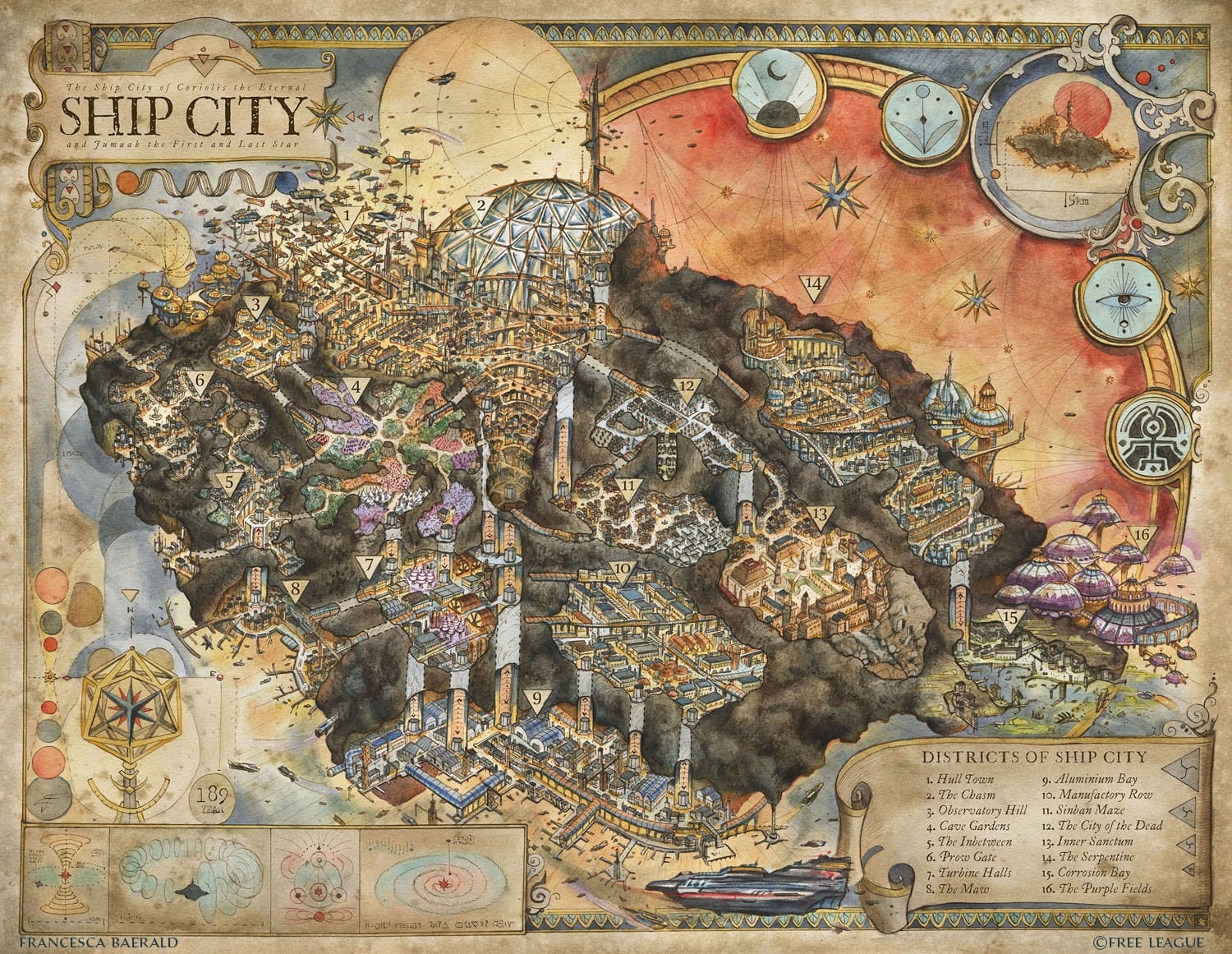
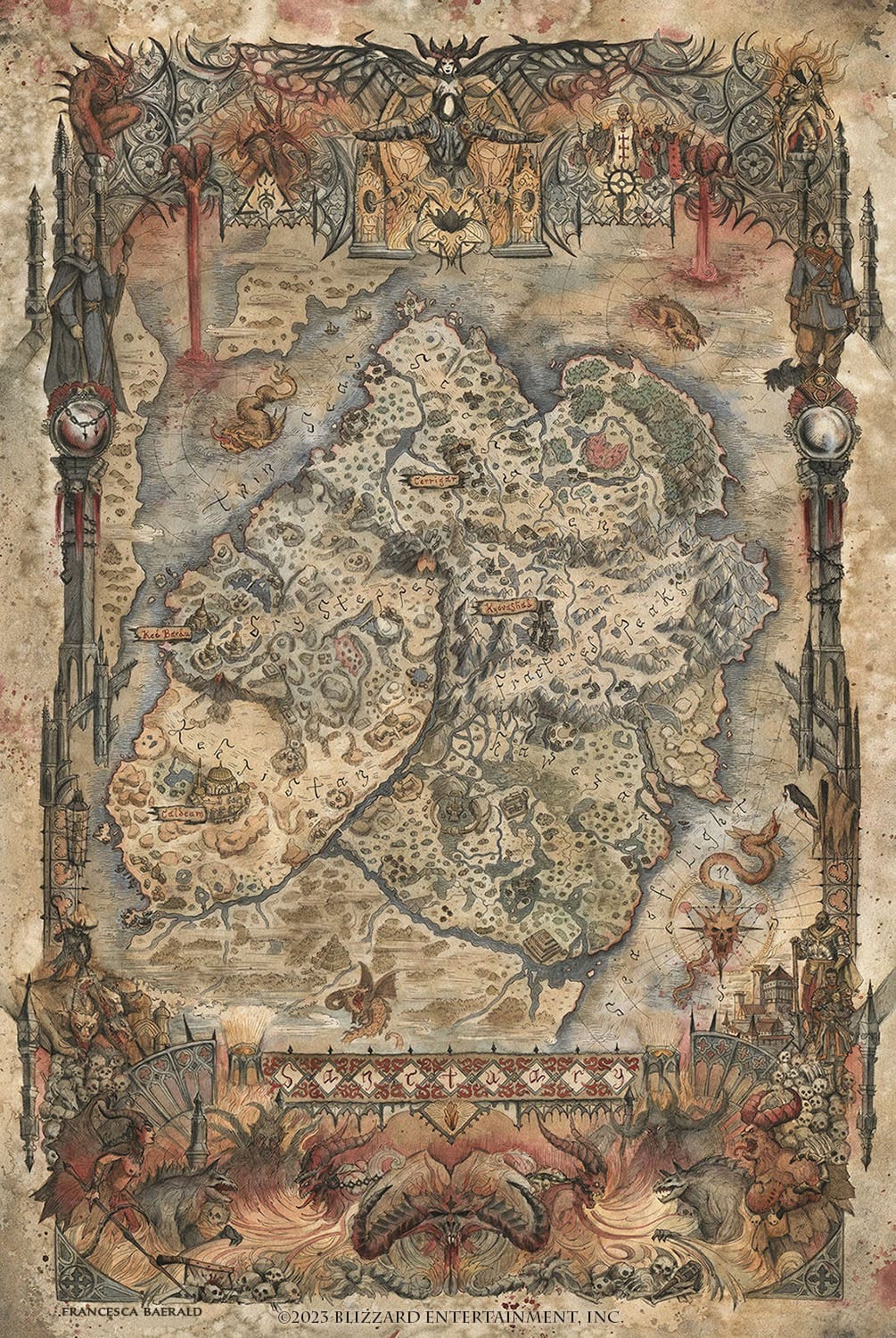
In some cases, I’m asked to create a map of a fictional world that I already know very well, like when I had the honour of creating the map for Diablo or the maps made for Dragon Age; in that circumstances it’s easier to know which are the important elements I want to depict on the map.
Have you ever discovered a geographical or narrative contradiction in the material supplied to you? How do you approach that conversation with the author or art director?
This has happened in a few rare occasions and I always think it’s best to talk honestly about it with the author or art director: we are all humans and we all may make mistakes. I usually ask if there is a specific reason behind the contradiction or the unusual natural feature, and then propose a more natural way of depicting it, if this is not connected to a story element. Lastly, I feel this is an important decision than needs to come from the creator; I can only propose options.
How much worldbuilding can a cartographer add independently before it begins to cross the boundary into rewriting someone else’s universe?
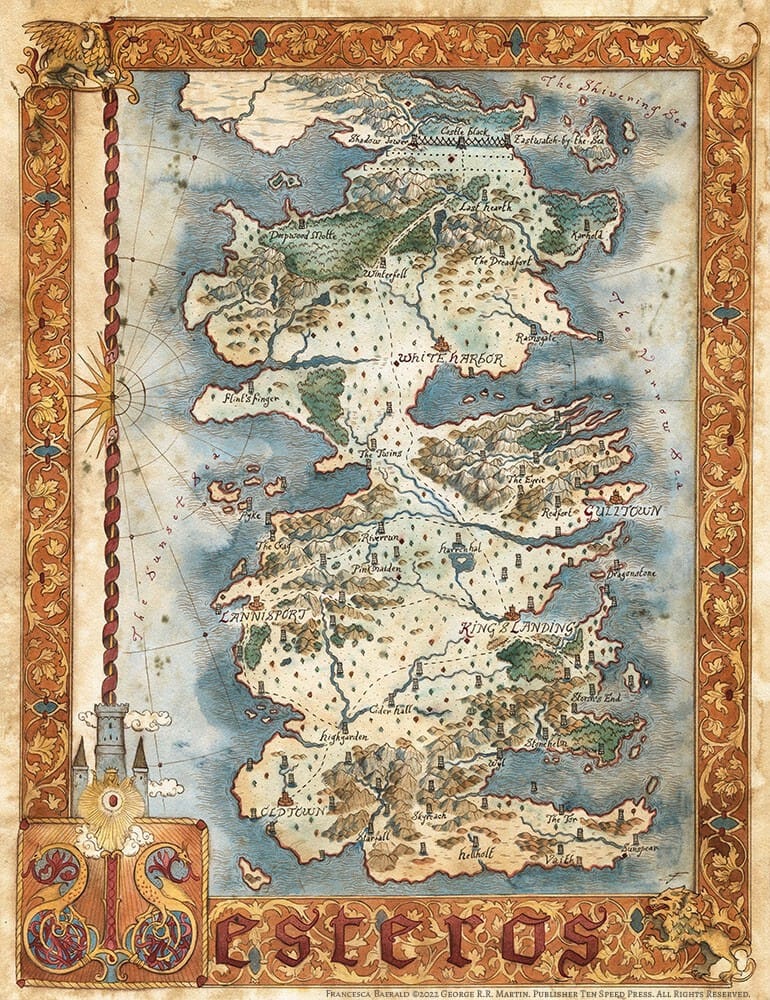
It depends on the kind of project and if the world has already been depicted in the past. If you are drawing a new map of a very famous setting like Azeroth from World of Warcraft or maybe Westeros from Game of Thrones, that have already been painted and described many times before, you cannot start adding elements just because you feel they would look nice.
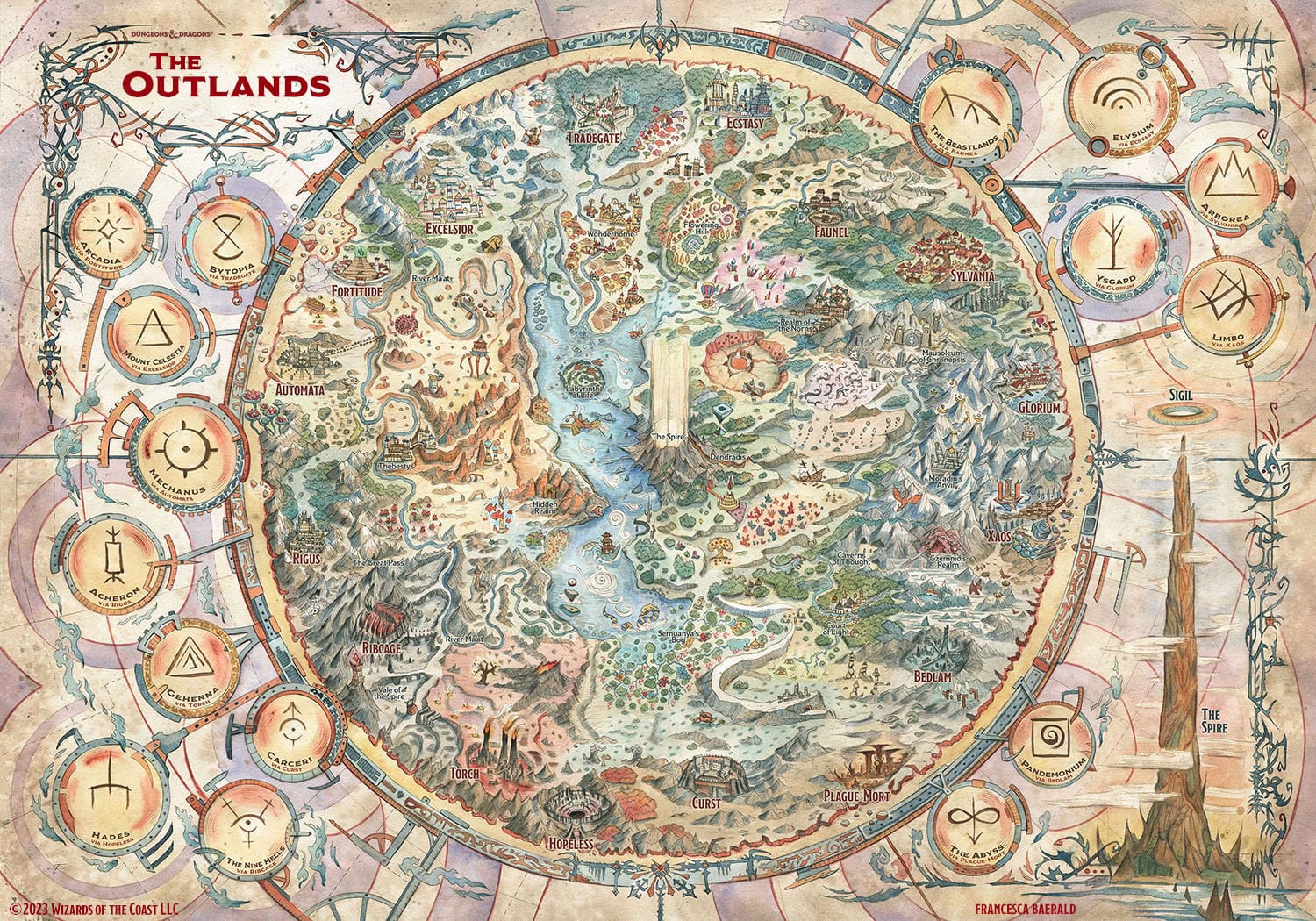
But in other occasions, like for example working on the new version of The Outlands from D&D’s Planescape setting, I was asked to be creative with the secondary elements on the map; I really enjoyed creating little stories and creatures scattered around the map that dungeon masters and players may use to create their own adventures.
What makes a fictional river, mountain range, or political border feel believable to you?
When I start working on a new map, I always try to imagine how would a character from that world depict the lands he/she lives in. Once you start looking at natural or artificial features with these eyes, everything becomes easier to depict in a believable way.
There are obviously also some technical matters to take in consideration, for example in a political map it is very important that borders are very visible and clear; in other kinds of maps, borders may be depicted in a less evident way. The same goes for other elements, like mountains or forests: you may be representing a region or a setting were mountains have a very significant role in the story. In this case it’s important to make them stand out like one of the key features of the map, treat them with the same respect people from those lands would do.
This means that you have to find a good balance between key features represented in a natural way and stretching those features to adapt them to the culture, history and flavour of the setting.
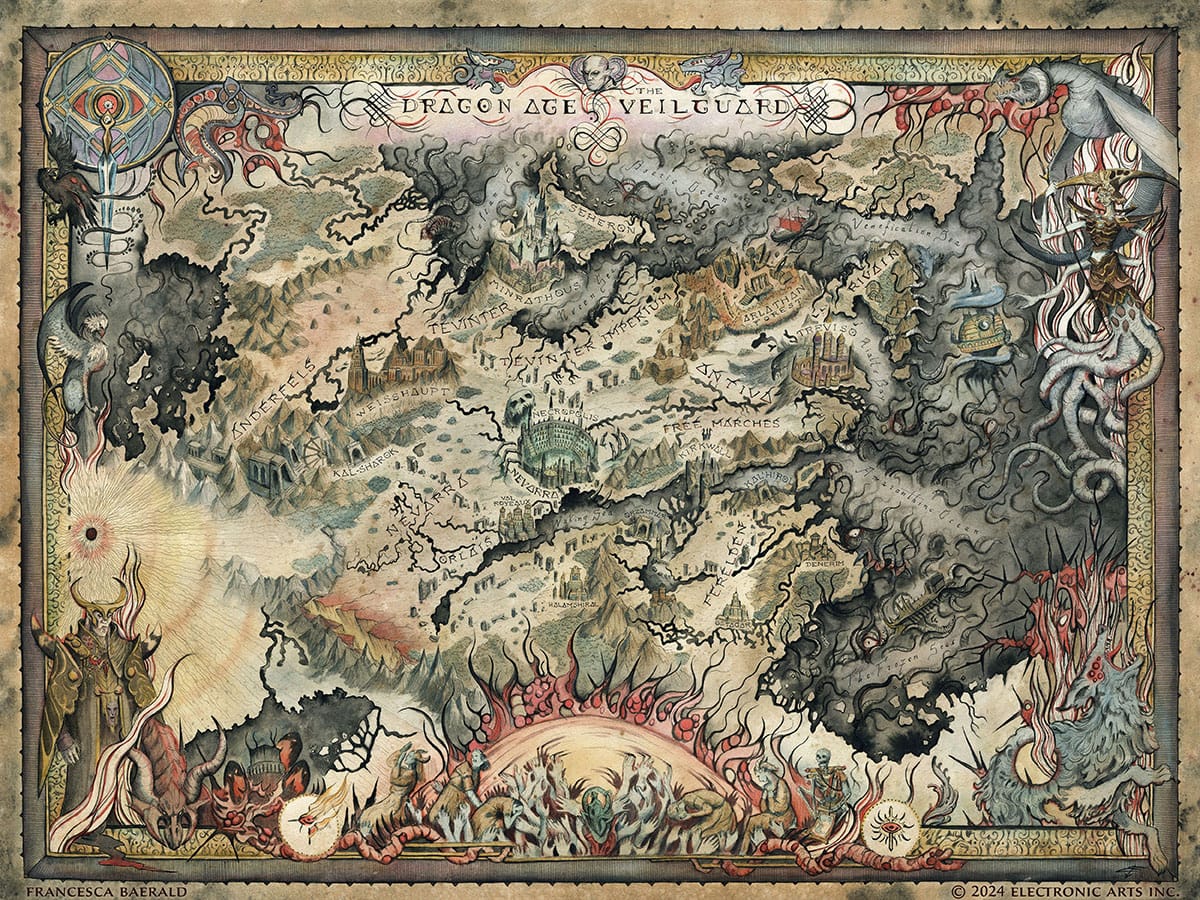
How do you design a map of a world containing several conflicting versions of its history? Should the map suggest which version is true?
This happens more often than you may think, especially for famous settings created a long time ago. In the rare occasions that I’m creating a map as a personal work, I like to study as much as possible of the lore and then I decide with version I believe is the truest to the original writer/creator’s vision: in the end my aim is to draw a map that honours the world created and envisioned by someone.
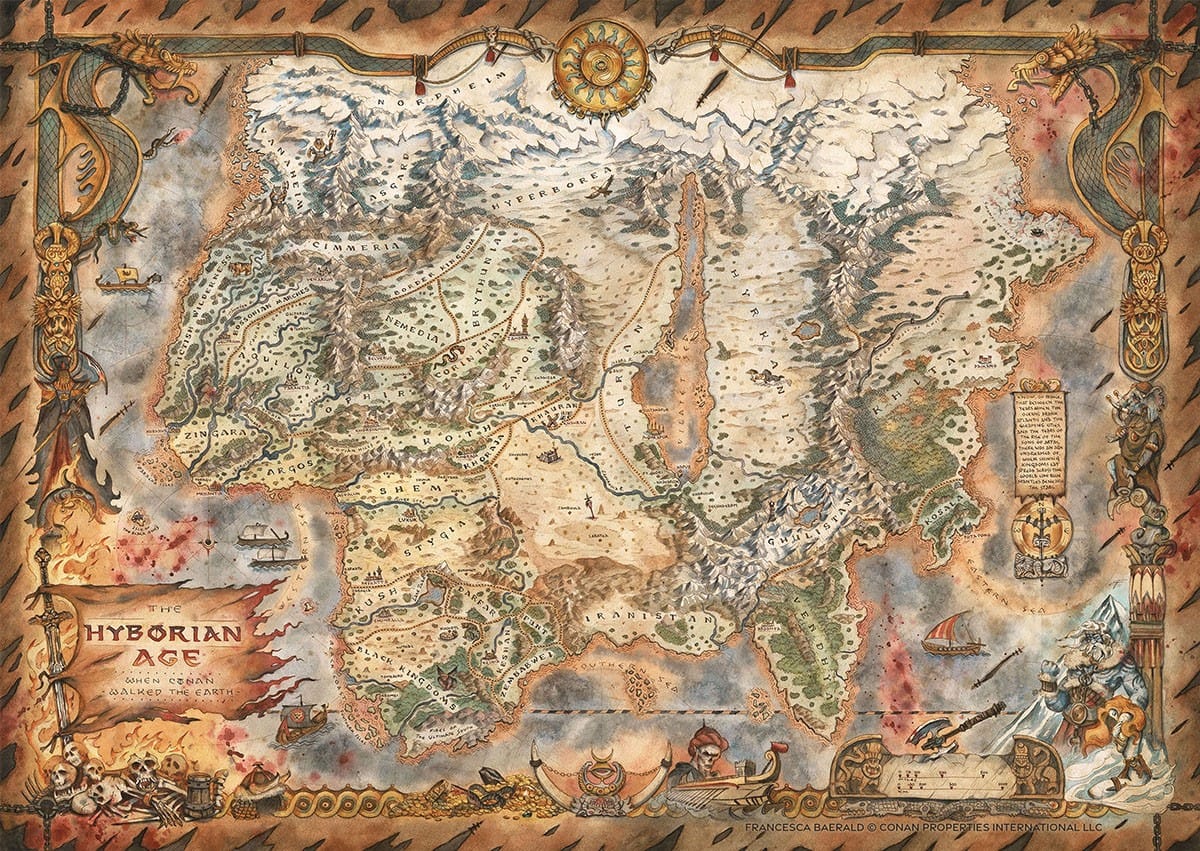
When painting the latest official map of Conan’s Hyborian Age, I was fortunate to have all the Heroic Signatures team and archaeologist/historian Jeffrey Shanks to assist me with the research; so in that case I was very lucky, otherwise the burden of creating something Howard (and his readers) would be proud of, would probably have been too much!
Furthermore, sometimes lands can be seen from different points of views (like from opposed factions or cultures from the setting, with a different history), so I have to decide from which point of view to represent the map.
Do you deliberately include details that viewers are unlikely to notice the first time they look at a map? What do these “secrets” contribute to the work?
Absolutely! I like to add small secrets in all my maps. As a player I really appreciate discovering little details on maps and explore every nook and corner; I believe this adds layers of continuous discovery to the map. So, when I’m on the other side and I have the privilege of drawing a map, I enjoy creating small elements that don’t break the main worldbuilding, but may attract the observant eye (maybe an unexpected monster, two characters discussing on a road, a mysterious tower or some fangs gleaming in the dark of a cave).
I think these details help to make the map feel more authentic and real, a little like what some scribes did in the past when creating illumination images for manuscripts.
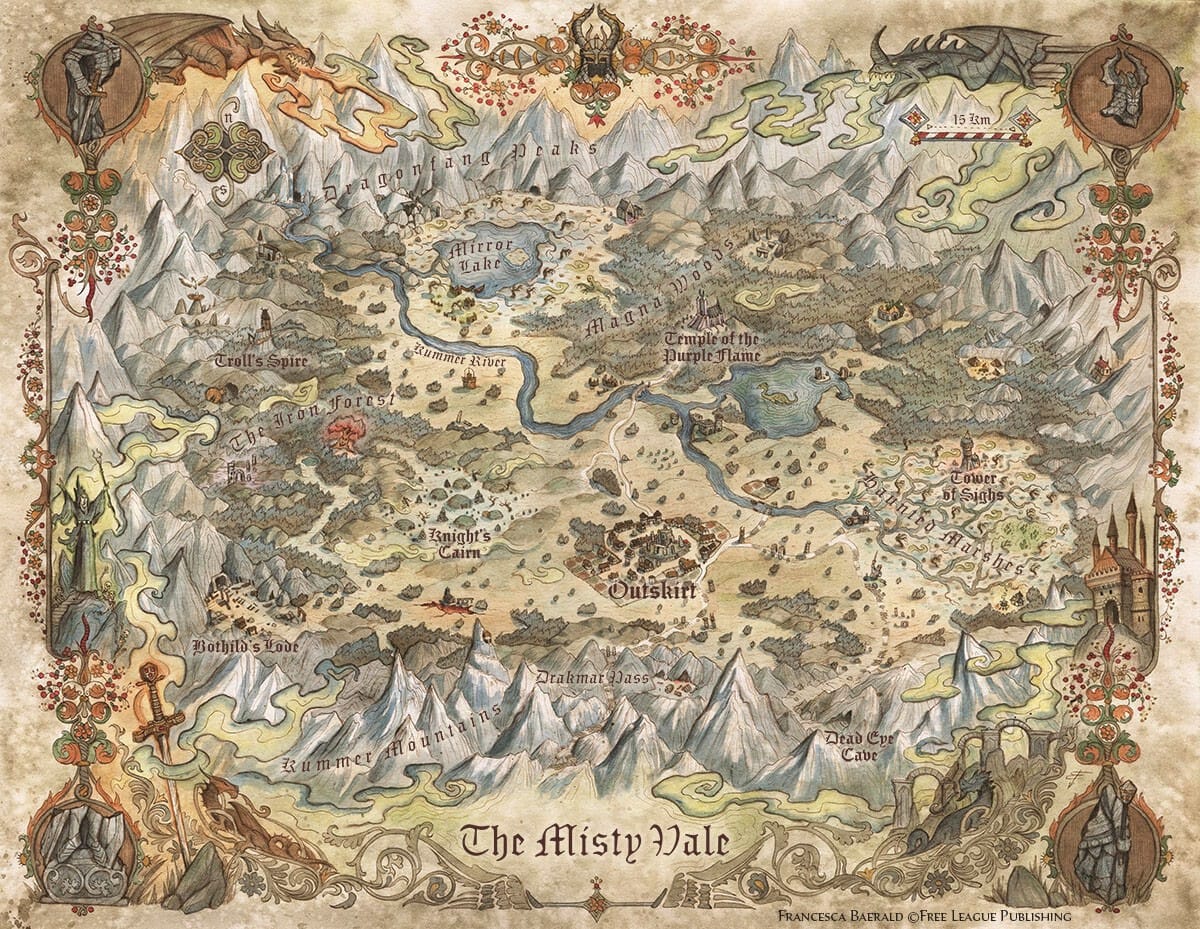
What can empty spaces on a map tell us about a world—particularly places that remain unnamed, unexplained, or outside the frame?
In art, like in cartography, empty spaces may narrate a story even more powerful than a fully depicted area. An empty space on a map can mean an area that hasn’t been explored yet and we know that human imagination loves to dream of unexplored lands! You have to build a balance between empty and full spaces, to leave room for discovery and wonder.
The famous ‘hic sunt dracones’ is the perfect example of how much uncharted areas may fascinate readers. But empty areas on a map can also tell you something important about the history and culture of the people connected to the map (like it does for ancient maps of the Earth): are they afraid of exploring those lands? Maybe they don’t have the technology yet to travel across distant oceans or are the lands forbidden by some kind of spiritual rule?
How does your thinking change when a map is meant to be used by a player during a game rather than viewed by a reader or spectator?
The way I approach the map is the same, because my aim is to transport you to a new world and make you eager to explore these new lands. What changes may be the additional features that the map requires. For example, a map for a book may want to track the characters’ journey on the it, while on the opposite a map for a videogame may have fog-of-war on all of the map except for the area you are in, so you must consider that the player will discover his/her adventure step by step.
Maps for boardgames like the one I have drawn for River of Gold may become a background illustration that helps the player immerse in the setting, but that must clearly show all the important elements crucial for gameplay. In general for games, there are some technical elements that are key to the natural development of the game experience that have to be taken into account.
Should a good game map always help the player, or can it sometimes be designed to mislead or disorient them?
It depends! When you start thinking of a map like a real in-world artefact, you understand that a map becomes a living thing. When creating the maps for Gothic Remake I really enjoyed working with different media to recreate the feeling of each map crafted in a different circumstance by a distinct character.
In the same way, a map can help you or mislead you based on who created it and for what reason. In general, a good map must always aim to help players understand where they are and where they can go. But if you think about it, the most famous maps of all – treasure maps – are the perfect example of a map that must mislead and disorient you, so that only who really knows how to decipher the map can find the treasure!
How do you decide which elements should be represented realistically and which can be shaped primarily by emotion and composition?
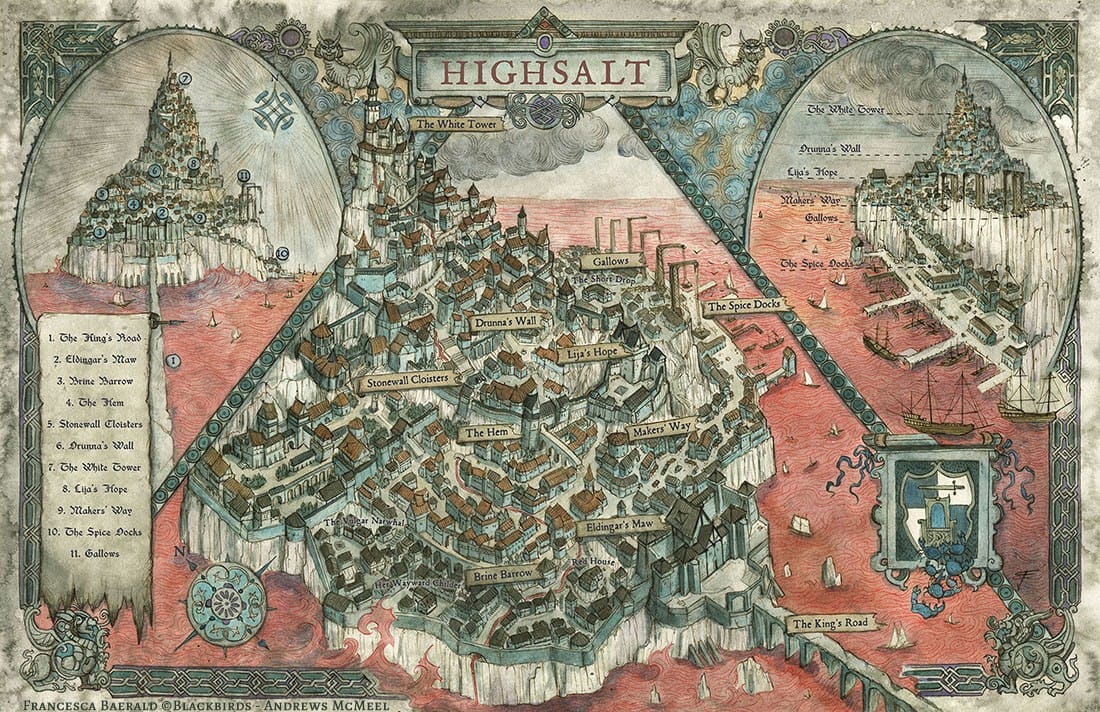
I usually reserve the main map area for the more realistic elements that depict the world (locations, natural features, etc), but choosing the right visual style and colour palette for the setting is very important to start shaping the lands emotional context. I like to try and test new compositions when creating maps, I once drew a map fashioned as an airship and also had the chance to paint a world shaped as a crescent moon. For example with the map of Blackbird’s Highsalt I decided to try a more alchemical visual approach.
Once the lands are ready, I then like to take advantage of the border decorations to really make the setting’s lore come alive, depicting adornments inspired by the world’s folklore and adding characters, creatures, locations and symbols that are distinctive.
There are also special instances when I have the chance to work on unique maps that have a less physical meaning, like the Celestial Realms map made for Legend of the Five Rings; I really enjoy having the freedom of creating a map that blends a traditional map concept with a more emotion driven illustration. I cherish these occasions as the perfect moment to try and push the map boundaries and create something new.
You work traditionally, often on projects requiring several rounds of approval. How do you leave room for revisions without losing the spontaneity of the original piece?
Experience has taught me that it is really important to study the setting and art brief with care, to understand the world you are going to draw but also what the team is looking to achieve with the map you are creating. Once I have a clear idea of what the map’s scope is, I can then try to create my vision of that specific world. Luckily I mostly work with very passionate and competent teams that appreciate and respect my work and are open to new ideas.
I then focus on producing a pencil drawing of the map (even a quick concept composition, if needed) and discuss about it with the designer or art director. Making changes on the pencil drawing is easier than once the maps is inked, so this is a delicate phase. Once the team is happy with the pencil drawing, I then move on with inks and colours.
With this approach things usually go well, without too many retakes on the final coloured map; but working traditionally means that sometimes you have to look for creative solutions to solve issues that may appear only once the map is complete.
What kind of feedback from an art director is most useful to you—and what kind is the most difficult to translate into an image?
Although I do my best to study a world in detail, art directors usually have a huge knowledge of the setting and their help in identifying elements that may make my map more faithful to the lore is irreplaceable: so any feedback in that direction is always appreciated.
The most difficult feedback to translate onto my maps are those that require various retakes on my initial idea, not because of the additional work, but because in some way these slowly alter my original concept and then I find it challenging to get back into ‘feeling the map’. This happens rarely, but when it does I really have to force myself to reset my mind-set.
What happens to your original maps after major commercial projects are completed? Is it emotionally difficult to part with them?
When I put down my brush after the final stroke on a map, I feel a bit sad knowing that I’m saying goodbye for the last time. But I also feel a bit of excitement in the fact that I will soon be travelling to another new world, while people will start building their own memories and adventures on my newly created map.
Sometimes commercial projects only need the digital version of my map, therefore I may keep the original, so there’s a little comfort in that. However in that case there are a few possible outcomes: the original may end hanging on the walls of my studio, may be bought by a collector around the world in the future or may be framed, ready to be shown during some exhibitions.
On the other hand, when one of my originals finds a new home with the team or creator that commissioned me the map, I’m happy to know it is in safe hands. Some of my originals are in Square Enix’s and Bioware’s studios, they are hanging in the office of the team that is writing the future of Conan projects or they are hopefully inspiring students in art schools and exhibitions.
It’s difficult to see the original go, knowing you may not ever see it again, but art should travel the world and reach as many people as possible, so it’s always an honour for me when one of my artworks is displayed somewhere.
Does the scanning and reproduction process affect how you choose colours, contrast, and very small details in the physical original?
Translating my work into a digital version of it is a very delicate process, but I guess this happens to all traditional artists. After years of refinement I think I’ve found a good combination between my monitor and scanner settings, so that the reproduction is quite faithful to the original. I must always do some digital colour balancing on the map, but I try to keep it to a minimum, to preserve the original authentic feeling of the artwork.
I also have to keep in mind the level of detail of the final print size, to avoid adding too many small elements that would not be visible once printed.
Fun story: I use an old scanner – I’ve tried to buy a newer and more expensive model, but the result wasn’t as good and faithful as my old one (maybe I was just unlucky), so I’ve found and bought an additional second-hand copy of my scanner, just to be safe, in case my original should break down one day!
Which part of the craft is the hardest to teach: observation, composition, patience, or decision-making?
I had the pleasure of teaching cartography only in a couple of rare occasions, so it’s not easy to answer. I’ve been asked to teach or hold online courses, but I don’t feel that would be the right thing to do at the moment in my artist journey (for me and for students). Being good at drawing doesn’t mean being good at teaching!
I believe observation should be a primary skill for anyone interested in art, while composition is something you may learn by mixing your observation skill with your creativity.
Patience is something we all have to learn in life, whatever you do, especially when you want to work with traditional media and on very detailed artworks; the good thing with art is that you may learn to approach it in a way similar to a meditation session.
Decision-making is probably one of the most difficult abilities to obtain, because as an artist you are never fully happy with your work and you must learn to guide your creativity towards something real and concrete, especially if you want to earn a living from your craft. Probably only hard work and experience can help you augment your decision-making skills.
How do you distinguish your recognisable visual language from habits that may eventually limit your artistic development?
As every artist, I work hard each day to shape and evolve my own unique visual language, trying to speak with my own voice in a world full of fantastic illustrators and creatives. This said, I like to approach my art in a very instinctive and natural way, and I love to challenge myself experimenting with new techniques. For example, when they asked me to paint the maps for Legend of the Five Rings, I chose to learn sumi-e painting and try to merge that with my map making, to give the maps an aura more faithful to the setting.
I approach each new project as a different adventure and my first aim is always to find a way to create something distinctive to the setting’s flavour and respectful to it. I still don’t exactly know what makes my visual language recognisable, but I’m glad to receive messages from people who recognize my style – it probably means I’m doing something right.
After years of working with famous fictional worlds, do you still feel pressure from their fandoms? How do you respond to audiences who already have a very specific image of a particular universe?
After years I certainly feel more confident, but when creating a map for a setting, I always experience the pressure of creating something people will enjoy. I know I can’t create a map that everyone will enjoy, because we all have different expectations, especially when thinking at fantastical world we have been exploring maybe since childhood.
I know the only thing I can do is respect the setting, draw my vision of the world and aim to paint a map that the creator of the fictional world would enjoy (or would’ve enjoyed).
If you could map one real place according to memories, emotions, and personal stories rather than physical geography, which place would you choose?
I would probably choose Alsace, the French region: I’ve visited it many times and each trip has made me discover and experience something new and exciting. The vineyard landscapes probably remind me of home (since I was born and live in an Italian region famous for its food and wine), the castles, wonderful towns and villages help me dream of chivalry times, while the storks’ nests make everything surreal. Also, if you happen to have the luck of visiting Alsace during the winter time, close to the festivities, the atmosphere becomes really magical; each town has its own winter market and some of them really manage to take you to a dream world.
Is there a fictional world you would not want to map because its geography should remain undefined in the audience’s imagination?
There are places like Lovecraft’s Dreamlands or the city of Springfield from The Simpsons that are ever-changing worlds that mutate based on the stories or the point of view of who is living it, and I really like this concept.
If you think about it the world we live in transforms based on our memories, on the observer and on the emotions we feel when we live an experience.
That is probably one of the main reasons why I consider more important for a fantastical map to manage to deliver the feeling and emotions of a setting, rather than depicting each element in the correct spot, with pinpoint precision.
Ironically I have already had the chance to depict the Dreamlands twice in my career.
What inspired you to create Unbound, and at what point did you realise that this body of work should become a book rather than simply a collection of individual maps and illustrations?
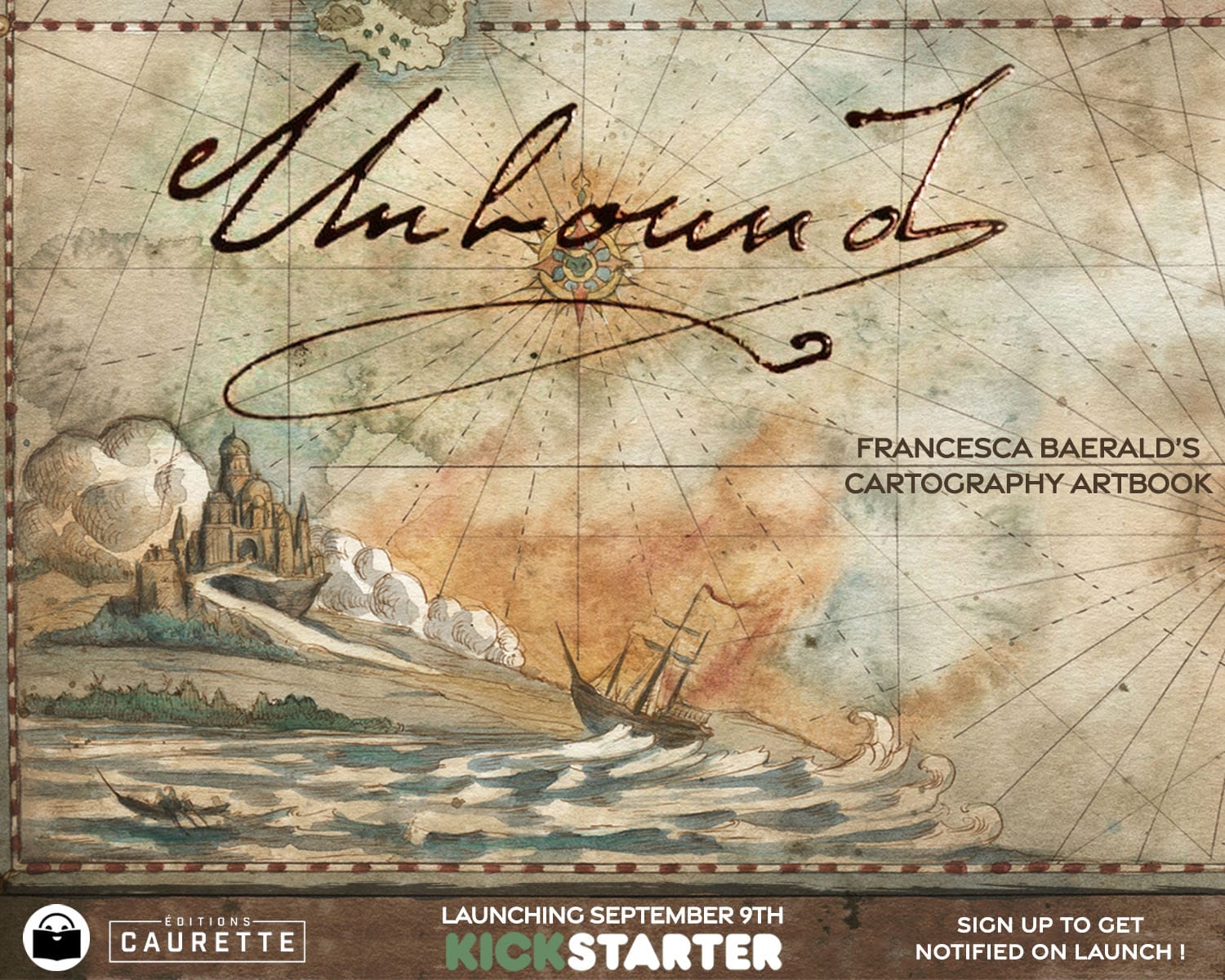
From a certain point of view Unbound is a collection of individual maps, because it gathers all the most important and fascinating maps I have painted in my 13+ years as a cartographer in one single book, but I’m trying to create something more than a simple artbook depicting my maps.
I have always had the dream of creating a book with my maps, but I never felt ready for it, until I had the chance to chat with the talented book designer Spiridon Giannakis who proposed to work together on it; it’s one of those once-in-a-lifetime moments, so I immediately accepted.
How did working on Unbound differ from illustrating established worlds created by other authors? Did complete creative freedom make the process easier, or did it bring a different kind of challenge?
Most of the illustrations that you will find in Unbound are maps that I have had the pleasure and honour of creating for famous settings and authors throughout the years. But I also wanted Unbound to feature some original artworks created especially for this special occasion that will also be the beginning of a new journey for me: the creation of my first set of maps made with complete creative freedom.
After years working with art briefs, author sketches and detailed descriptions, it’s refreshing to be able to have total control on these maps, but it is also very daunting. I’m lucky to already have a deadline (and other upcoming projects), because otherwise I would probably continue painting and fixing each one of these maps forever.
I’ve been working on these personal maps in the past months and weeks, and I still don’t know where this new adventure will take me, but I really hope people will enjoy these maps, once they see them.
What kind of journey would you like readers to experience as they move through Unbound, and are there recurring visual themes, details, or connections they should pay particular attention to?
As I mentioned, I don’t want my artbook to be an ordinary collection of my maps: the first thing I thought of was how to showcase the maps in a way that I felt was mine. I immediately discarded the idea of categorizing the maps by project or to display them by year of creation.
I would like to create an experience that helps readers travel to different worlds and as you know I think emotions are very important when journeying to new lands, so I’ve decided to divide my maps in various chapters, each one connected to a different mood. The moon as a symbol will also have a pivotal significance in this chapters subdivision, representing through key illustrations a visual aid to guide you across this journey in maps.