The Future Is Digital-First, Not AI-Written: Inside Nord Games’ Next Chapter
Nord Games has been part of the tabletop RPG landscape for more than a decade, building a catalog that spans bestiaries, NPC books, settlements, traps, card decks, and now digital tools. In that time, the company has seen Kickstarter evolve from a relatively open frontier into a crowded, data-driven marketplace where prelaunch followers, audience ownership, advertising efficiency, and community trust can determine whether a campaign succeeds before it even goes live.
In this interview, Chris Haskins talks candidly about what still works in crowdfunding, what has become harder since 2020, and why repeat backers are often won through reliability rather than hype. He shares practical lessons on stretch goals, paid ads, influencer marketing, fulfillment, email lists, Discord communities, and the difficult economics of publishing physical RPG products in 2026.
The conversation also turns toward one of the biggest debates in the industry: artificial intelligence. Nord Games draws a firm line between AI as a productivity tool and AI as a replacement for human creative work. At the same time, the company is investing heavily in Oracle RPG, a digital-first platform designed to make its 15-year catalog faster, easier, and more useful at the table without removing the Game Master from the creative process.
For creators preparing their first Kickstarter, Chris offers a blunt but valuable piece of advice: build the audience before the product. For publishers trying to survive the next decade, his view is equally clear. The future belongs to companies that understand community, protect quality, and know exactly what problem their products solve.
Onwards!
You've been running Nord Games since 2011, with multiple successful Kickstarter campaigns for products like Ultimate Bestiary, Spectacular Settlements, and more recently Oracle RPG. What were the key elements that helped you establish early momentum in your first campaigns?
In the earliest campaigns, we leveraged our artwork and focused on creating something unique that had not been published before. We produced Bestiary and NPC books that offered more content than other titles in the same category, which helped us stand out early on.
How has your approach to Kickstarter evolved from those early days to running campaigns in 2026? What lessons proved most durable over time?
Early on, there were no prelaunch pages, so we relied heavily on email marketing to build an audience before going live. That has changed significantly. Today, your follower count on a prelaunch page is one of the best indicators of whether you're ready to launch.
There's a straightforward formula: estimate your average pledge, multiply your follower count by a roughly 10% conversion rate on day one, and see if that gets you to your funding goal. The bigger shift since 2020 is that advertising costs have risen dramatically and the market has become far more crowded. The campaigns that tend to perform best now are from creators who already have a strong social media following on platforms like YouTube, TikTok, or Instagram, because they can direct their entire fan base to the project before and after launch.
Many creators struggle with stretch goals — some avoid them entirely for reliability, others use them to drive mid-campaign excitement. What's Nord Games' philosophy here, and how has it changed?
If stretch goals can be created without causing significant delays or extraordinary costs, we're all for them. The problem is when creators announce stretch goals that complicate fulfillment or erode profit margins. My advice is to plan and budget every possible stretch goal before the campaign goes live.
Determine whether each one will cost money, time, or both, and make sure it genuinely adds value for backers. Upgrading materials — such as thicker paper or adding full-color artwork — are good examples of stretch goals that excite people but require careful budgeting before you commit to them.
Nord Games has built a significant catalog over the years. How do you decide when to return to an existing product line versus launching something entirely new?
We typically plan our series in advance, knowing from the start whether a line will be two, three, or four books. When deciding whether to continue or move on, we look at the market to assess whether there's still a need and whether we've exhausted what we can offer.
We survey customers, evaluate the competition, and budget carefully. If a concept would require, say, a thousand pieces of original art, we assess whether that's financially viable or whether it needs to be scaled back. The products we find most valuable are those that serve multiple purposes within a single book. For entirely new ideas, we maintain a long list of potential titles that could carry us several years into the future, so we always have a pipeline to draw from.
With BackerKit and Gamefound growing as alternatives to Kickstarter, how do you decide which platform to use for a given project? Have you considered moving away from Kickstarter?
We tried BackerKit for one campaign and it did not go well. The core issue is that Kickstarter's built-in audience and foot traffic are significantly larger. Customers who had only ever seen us use BackerKit for pledge management were confused when we launched a full campaign there, and that created real problems.
BackerKit has improved and offers features that are genuinely better than Kickstarter's in some areas, but the reach simply isn't comparable — at least not in our experience. As for Gamefound, my understanding is that it performs particularly well for board games with miniatures, tiles, and cards. For tabletop RPG content, Kickstarter remains the strongest platform for visibility.
Can you share one marketing decision or campaign strategy that didn't work out the way you hoped — and what you learned from it?
Influencer marketing has been very hit or miss for us. Since 2020, our average return on ad spend has hovered around 3:1 or lower, which makes it hard to justify in many cases. Before 2020, we were regularly seeing returns of 5:1 to 10:1, with occasional spikes as high as 20:1.
The market has changed significantly — there are more publishers competing for the same audience, and more advertising dollars chasing the same eyeballs on platforms like Facebook and Instagram. The lesson is that a return on ad spend above 1:1 doesn't automatically mean you're profitable once you account for all the associated costs. You need to calculate your true break-even point and target well above it.
Looking at your social presence (Discord, YouTube, Twitch, TikTok, Instagram) which channels actually convert to backers, and which ones are more about long-term community building?
Each channel serves a different purpose and reaches a different demographic. Facebook tends to skew older and is useful for brand recognition but less effective for driving immediate conversions. YouTube and Instagram reach a somewhat younger audience and have grown steadily for us. TikTok is our newest focus, so it's too early to evaluate.
Discord is our smallest community but by far the most passionate — these are people who sought us out and actively want to engage. When we post an update there, the response is immediate. For paid advertising, Facebook and Instagram are still valuable for broad brand awareness, but Discord is where we see the deepest engagement from our most loyal supporters.
Email lists are often called the most valuable asset a creator can own. How large is Nord Games' list today, and what's your approach to growing and maintaining it between campaigns?
Our list has fluctuated quite a bit over the years. We collect signups through account creation, purchases on our website, and social media channels. Periodically, we cull the list by segmenting out subscribers who haven't engaged in a long time, sending them a re-engagement email, and removing those who don't respond. That keeps the list clean and the engagement metrics accurate.
Despite the fluctuations, email continues to drive significant sales — our recent spring sale generated strong revenue every time we sent a campaign about it. I suspect our email audience skews toward the 35 to 65 age range, which is why we invest in other platforms to reach younger audiences. For anyone building from scratch, I'd recommend starting with something like Mailchimp and consistently delivering useful content so that when people open your emails, they're glad they did.
How do you turn first-time backers into returning supporters? What percentage of your backers typically come back for the next campaign?
Upward of 50% of our backers return for subsequent campaigns, which we can track through platforms like BackerKit. I believe this comes down to quality — both in the physical product, whether that's the binding of a book or the construction of a card deck, and in the content itself. When people trust that what they receive will meet a high standard, they come back. That said, the total number of backers per project has fluctuated with broader economic and geopolitical factors that affect discretionary spending, so repeat loyalty doesn't always offset those headwinds.
The TTRPG market is more crowded than ever, with dozens of campaigns launching every week. How does Nord Games stand out in 2026 when attention is so fragmented?
It's a challenge we think about every day. The confusion around the 2024 revised fifth edition — now being called 5.5 — has fragmented the customer base even further on top of an already crowded market. Our approach is to build products that our own team would genuinely use at the table.
We ask ourselves: what problem does this solve? Does it save time, spark creativity, and make the game more fun? Those three values — inspiration, efficiency, and fun — guide everything we make. We're not trying to rehash existing content; we're trying to identify real gaps and fill them with something that earns a permanent place in someone's kit.
Customer acquisition costs for tabletop games on Facebook/Instagram now range from $15–50 per backer. At what average pledge value do paid ads become profitable for you — and do you still rely on them?
The key is knowing your target return on ad spend before you start. The math is straightforward: take your total costs at a given pledge level — production, fulfillment, platform fees, and so on — and determine what margin you need to protect. If your costs consume most of the pledge value, a 2:1 return on ad spend might still leave you with very little. We generally find that 1.5:1 is roughly breakeven when all costs are accounted for, so we target 2.5 to 3.5:1 or better. Anything below that, especially for newer publishers without the margin to absorb losses, can be very dangerous.
Have you collaborated with actual play streams, podcasts, or influencers to promote your campaigns? If so, what worked — and what didn't justify the investment?
Yes, and as I mentioned earlier, it's genuinely hit or miss. The most important factor is not follower count but engagement rate. A channel with a million subscribers but low engagement will often underperform a channel with 200,000 highly engaged followers. Before committing to an influencer partnership, we research how their audience interacts with their content. High view counts and high subscriber numbers can be misleading — what matters is whether those followers act when that creator recommends something.

Global fulfillment has become increasingly complicated — tariffs, rising shipping costs, customs delays. How has Nord Games adapted its logistics and pricing strategy to handle this?
We used to invest heavily in international distribution, with multiple warehouses across different regions. After 2020, that model led to significant losses. We've since shifted to a US-centric approach, consolidating into a single warehouse. International customers are now responsible for their own shipping costs. We found that the overhead and risk of maintaining an international fulfillment network outweighed the benefits, at least at our scale. It's not a perfect solution for international backers, but it's a more sustainable model for us.
Some in the industry talk about "backer fatigue" — the sense that communities are tired of constant crowdfunding asks. Do you see evidence of this, and how do you address it?
There is some fatigue, but a lot of backers also simply expect publishers to run campaigns on a regular schedule — it's part of how this industry operates. The harder challenge is explaining that we're not a one-project-at-a-time shop. At any given moment, we have titles in the design phase, the campaign phase, the production phase, and the fulfillment phase simultaneously.
When we launch something new while another project is still being fulfilled, some backers raise concerns. Our answer is transparency: these are separate projects on separate timelines, and we have a track record of delivering. The other issue is backer fatigue born from bad experiences with other publishers. When someone has been burned on a different campaign, they sometimes blame the platform rather than the publisher. Winning that person back requires demonstrating reliability over time, and that's a slow process.
The ENNIE Awards banned AI-generated content starting from the 2025–2026 cycle. DriveThruRPG has similar restrictions. What is Nord Games' position on using generative AI in books, art, or text?
Our position is clear: no AI for any creative work, full stop. Using AI for data organization, summarizing spreadsheets, or other non-creative tasks is a different matter — that's a productivity tool. I’m actually using Claude to conduct this interview. I fed it your questions before going on a trip into town to run errands and I’ve been answering the questions for the past 15 minutes or so. That’s productivity and a good use case to be more productive with AI.
But AI-generated art and AI-written creative content have no place in our products. We want everything we publish to be made by human hands and human minds. If we need artwork and we can't draw, we hire talented artists. That's not a compromise — it's a commitment to the community and to the craft.
Oracle RPG is a digital tool with procedural generators for stories, characters, and monsters. Where do you see the line between "digital tool that supports creativity" and "automation that replaces human creation"?
Oracle RPG still requires a human interpreter. It generates inspiration and content very quickly, but the Game Master still has to take that output and decide how to use it, adapt it, and weave it into the story. It's no different in principle from opening a book with a hundred pre-written settlements — except that because Oracle RPG draws from hundreds of tables with thousands of variables, the possible combinations are effectively limitless. The tool doesn't make decisions. It gives the Game Master something to work with instantly, which saves time and sparks ideas. The creative act is still entirely human.
Have you experimented with AI tools like ChatGPT, Midjourney, or others in your workflow at Nord Games? If so, in what capacity?
We do not use AI tools for any creative work at Nord Games. Productivity is a different story. Our website for example has an AI assistant that makes things like accounting, paying taxes, and handling all the minutia of running an ecommerce store far easier. Also, tools like ChatGPT or Claude can help when doing research. I recently asked Claude to give me the benchmarks for ecommerce conversion rates and expected trends on advertising return on ad spend. This can save a lot of time and streamline the whole process of running a business.
Looking ahead 3–5 years, how do you think AI will reshape the TTRPG industry — as a threat, an opportunity, or something in between?
I think we'll see a divide between creators who use AI to produce large volumes of low-quality content and those who continue to do the work by hand. The difference is something that's genuinely hard to qualify but easy to feel. There's a quote I've come across that captures it well: 'I didn't believe in a human soul until I looked at AI art.' That gap — between work made by a person who has invested years of skill and passion, and content generated by a machine — is real, and I think audiences will continue to sense it even if they can't always articulate why.
My concern is not with people experimenting privately with AI, but with the normalization of publishing and profiting from AI-generated work. When you replace a human artist with a prompt, you're removing that person from the creative economy entirely. There are alternatives — stock art, commissioning work at various price points — and I'd always encourage creators to explore those rather than defaulting to AI.
What advice would you give to a first-time TTRPG creator trying to run their first Kickstarter in 2026 — especially someone without an existing audience?
If I were starting over today, I would build an audience before building a product. That means committing to a social media presence — YouTube, Twitch, TikTok, wherever your potential audience already spends time. Create a brand or persona around yourself, show up consistently, and make it as easy as possible for people to find and follow your content.
Once you've built that community, you'll have an audience that trusts you and wants to support what you make. If you're sincere about what you're doing and you're genuinely contributing something valuable to the hobby, you will find your people. The product should come second — the relationship with your audience comes first.
What's next for Nord Games? Are there new product lines, genres, or platforms you're exploring?
The biggest initiative is Oracle RPG, our cross-platform app that brings our entire 15-year catalog into a single digital tool. What used to take hours of flipping through books can now be done in seconds. Every product we've published is going onto the platform, and everything we publish going forward will be available there as well. We're also making a deliberate shift away from large physical inventory.
Before 2020, we were stocking thousands of units for distribution and retail, and that model no longer makes sense for us — or, frankly, for many publishers in this space. The future for Nord Games is digital-first, with Oracle RPG at the center of that strategy.
That said, we will still make physical products. Right now, we are planning a series of books called the “Iconic Series” where we will use each book to focus on a single topic. We did a survey recently and found out that our fans want things like Iconic Landmarks, Iconic Adventures, and Iconic Settlements as those were a few of the top voted titles.
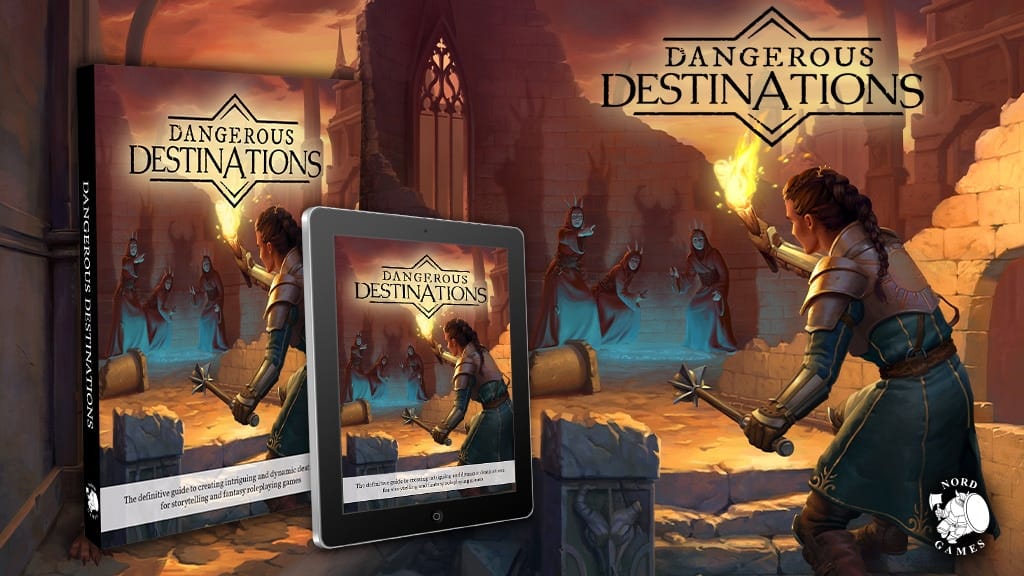
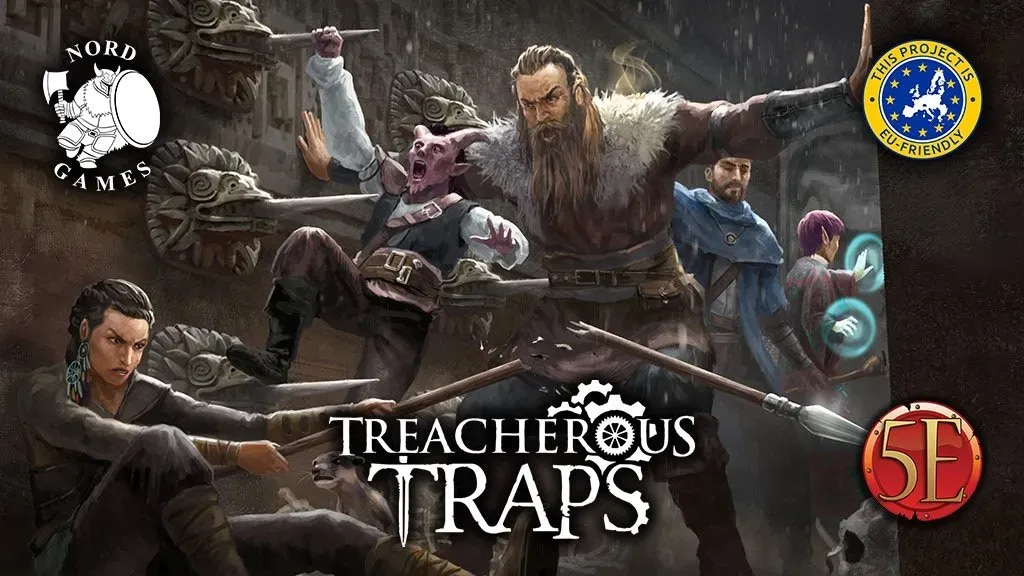
We are also looking at adding to our Treacherous Traps product line with a Treacherous Traps 2 hardcover book and card deck box set. That may lead to a Treacherous Traps 3. No matter what, we have many years of exceptional products ahead.
This interview is presented in partnership with Strigovia.
Strigovia is a dark, Slavic-inspired tabletop RPG where what we call “magic” is not a gift, but a debt owed to the ancient Forest — a power that listens, remembers, and always collects. There are no carefree spells or heroic fireballs here, only whispered rituals, blood-bound bargains, and slow transformations waiting for those who ask for too much.
This is low-fantasy horror focused on survival, painful choices, and stories that linger long after the dice stop rolling.