"I'm a Difficult Bastard": Grim Jim on 25 Years of Making Games His Way

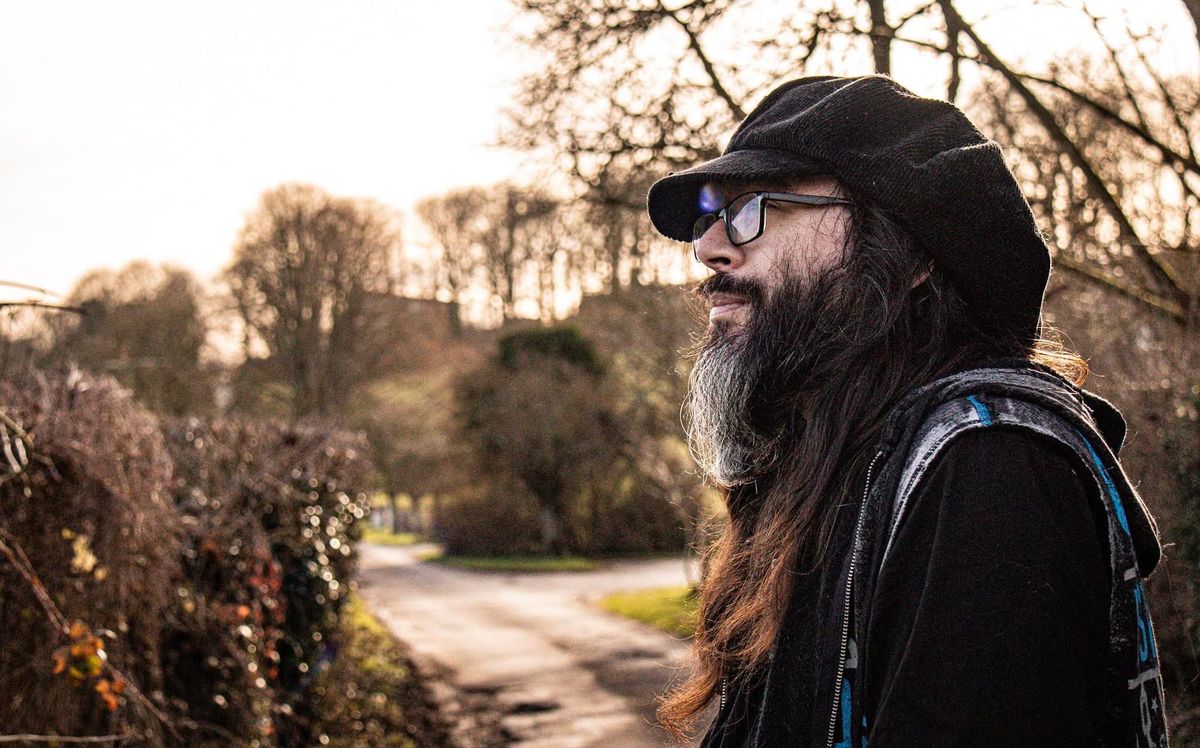
James "Grim" Desborough has been making tabletop RPGs for more than twenty-five years. He won an Origins Award for The Munchkin's Guide to Powergaming, spent a stint as line editor on SLA Industries, and has run Postmortem Studios through the arrival of PDF publishing, the OGL panic, crowdfunding, and most of the distribution collapses in between. He has also picked up a reputation along the way, which he describes himself as "a thin gruel of supposed transgression" sitting where the work should be.
His new project is Stray Crows, a three-book samurai RPG — Ronin, Three-Candle Crown and Autumn Moon — set in a Sengoku-era Japan assembled from folklore, chanbara and travel literature rather than katanas bolted onto western fantasy. The crow of the title isn't the European ill omen; it's the ambivalent Japanese one, Yatagarasu, sun-bird and guide, alongside death, autumn, solitude and impermanence.
The genuinely unusual thing about the campaign isn't the setting. It's that all three manuscripts are already written and playtested. The Kickstarter pays for artwork and hardback production, nothing else, and fulfilment runs through print-on-demand — books printed in the backer's own region rather than shipped across two oceans and stored in someone's spare room. "I don't like to go to people for money unless I can assure them that they absolutely will get something," he told us. Worst case, backers get Word documents.
We talked about all of that, and about the parts of the job that don't fit in a campaign update: anthology-style play and what Japanese story structure does to an adventure's ending; why he thinks the OSR tag doesn't quite fit him; what it costs to run a publishing schedule around chronic depression, anxiety and chronic pain; and the first generation of this hobby ageing out uninsured and unremembered — a problem he was working on with the designer Edward Kopp until Kopp's death from a heart attack earlier this year.
Onward!
Give me the elevator pitch for Stray Crows as if I were standing at a con booth with about thirty seconds before my group dragged me off to a game. What is it, and who is it for?
Stray Crows is a complete role-playing trilogy of swords, sorcery and survival in the age of the samurai. Ronin provides the fast, deadly core rules for historical adventure; Three-Candle Crown opens the door to spirits, monsters and forbidden magic; and Autumn Moon adds solo play, campaign tools and support for the games master. Together, they give you everything needed to tell grounded historical dramas, supernatural horror stories or wandering-swordsman epics in a Japan torn apart by war and ambition.
The project spent years as Ronin before you put the name to a public poll. Why "Stray Crows" in the end - and does a name that doesn't instantly scream "JAPAN" at people worry you commercially?
Stray Crows is more evocative, I think. The symbolism of the crow in Japanese mythology is more mixed, rather than being an ill-omen as it tends to be in European folklore. In Japan, the figure of the crow is more ambivalent. Yatagarasu is the Japanese version of a three-legged yokai crow, associated with the sun and magical guidance, he's one of our game symbols, alongside plum blossom, the lotus and Japanese maple. Crows also symbolise death, disaster, autumn, solitude and impermanence. Which are all resonant ideas within Stray Crows. The default for the game is that players are outcasts and survivors wandering through a ruined country; scavengers following war; ominous figures viewed with suspicion; but also unexpected guides, carrying messages from powers beyond the human world. The idea of a stray, wandering or feral crow as a way to describe a ronin or other wanderer, works in all three subsections.
You've described the game as historically plausible with the supernatural as an option, and a horror-leaning solo mode on top. Three settings in one set is a design choice with real costs. How do you keep that from becoming a game that does three things adequately and none of them well?
Everything is built upon that base of the historically plausible underlying game. Even if you don't include magic and monsters, people still believed in them. I know that people like to incorporate the supernatural in their gaming, but I wanted it to stay grounded in the folklore, myth and history of the time period. Whether magic and monsters are real or not is up to your table, but you have options. The solo game sub-setting is created as an excuse as to why you would be wandering completely alone and the problems you can run into while doing that - monster hunting and so on. So it's to facilitate a particular interpretation, though you don't have to go along with it.
You've said the tone is less epic saga, more Mad Max wandering into other people's problems. What does a ronin actually do in a typical session, and what does the system reward?
The game is aimed at what I call 'anthology play', which is more like how people used to play. You have your characters, you play through a module, and then move on with the same characters but into an entirely new story. The continuity is the characters. As we've found in playtesting, the way things tend to go is just like that, anthology series where the wandering samurai (or other classes) get caught up in local problems because compared to the villagers they are competent and dangerous. If not Mad Max, perhaps Knight Rider or any of innumerable other series that track a competent protagonist getting entangled in other people's problems.
Ronin, Three-Candle Crown, Autumn Moon - how do the three books divide the work, and can someone back only the first and still have a complete game?
Ronin is the core book and it has everything you might need. A cast of standard NPCs, character creation, play rules, the core of the magic system and a whole bunch of material about Japanese-style storytelling, GM advice and primers on various aspects of culture etc in a digestible form. You could just get that book, and you'd have enough to run a purely historical campaign, or perhaps a little more. Three-Candle-Crown has a primer on the Japanese concepts of magic, which differ from those in the west.
Then there's a whole bunch of spells, and a massive list of different yokai, each with an adventure seed to go along with them. Lastly, Autumn Moon describes the horror setting, provides advice on oracles and adjudicating single-player gaming. It's also chock full of tables and inspirations which serve both the single-player, and the GM (Sensei) who is hard up for ideas.
You're drawing on chanbara, folklore, travel literature and Japanese dramatic structure rather than dropping katanas into a western fantasy frame. What's one specific structural thing you took from Japanese storytelling that a western designer wouldn't have reached for?
The denouement is very different in Japanese traditions of storytelling than in Western act structures. The end of a Japanese traditional story more often ends with a shift in focus and meaning, than an outright climax or boss fight. That and the performance art of Rakugo have had an influence on the way I construct and tell adventures now.
You've called the game a partial homage to Bushido and Sengoku. What did those games get right that nobody has bothered to do since — and what did they get badly wrong?
Bushido was the first, and as such very much an artefact of its time. As the first it broke a lot of ground but the presentation and explanation of the rules and ideas were rather scant. Genre emulation wasn't really a thing back then either, so it's not that they got things badly wrong, it's just that the assumptions and techniques have developed since then.
Re-examining old-school games and retroclones was part of what got you here. After twenty-odd years of the OSR, what has that movement genuinely recovered, and what has it just fossilised out of nostalgia?
I get tagged with the OSR hashtag (or brand) but that's not really where I'm at. I'm somewhere between old-school play and narrative-oriented play in my own personal taste. What I like about the idea of it, is that there's often something to learned by going back to basics and then rebuilding from there up again. Some of the ideas from my previous explicitly old-school effort, Machinations of the Space Princess, also turn up here. Stray Crows is a lot less explicitly 'Old D&D' cloning, but there are core commonalities (as there often were in early TTRPGs) that translate across.
Old D&D also forms a useful 'lingua franca' through which people can interact and understand one another, or spend more focus on creating interesting game worlds and ideas. Lastly I think old-style play has helped to preserve descriptive play, where you have to tell me HOW you're going to seduce the dragon, not just make a persuasion roll. Where you have to tell me how you're searching the room, not just making a roll. I think there's a happy medium between the two somewhere.
You've kept working in that space recently - Kingdom for Lamentations of the Flame Princess, for instance. Is old-school design still generating new ideas, or is it now mostly a distribution niche and an aesthetic?
I enjoy experimenting, and I like 'difficult' ideas. For all its faults, the OSR space is more forgiving of those sorts of explorations than mainstream or 'indie' gaming. Lamentations is different because it unreservedly embraces the weird and transgressive, while also - sort of - being placed within an Early Modern, European setting - which with famous ancestors from the English Civil War, I find especially fascinating. Kingdom was an experiment in a prestige format, high-concept adventure. Not entirely successful, but again an experiment and taking risks. I don't like pre-written adventures, but could I write one that I liked?
Where does Stray Crows sit on the trad / OSR / story-game map, and is that a design position or a market position?
System-wise it hoves quite close to standard OSR ideas, you could convert to and from Stray Crows with a little work. There are system quirks and fixes which I think take it more towards a narrative game, but it retains a degree of crunch which has been missing from a lot of modern game design, without going overboard. So it's not new exactly, but it's a culmination of ideas, experiences and streamlining taken from all my years of design.
All three manuscripts are finished and playtested before the campaign launches. In this industry that's practically eccentric. Why did you do it that way, and what did it cost you to sit on completed work?
I don't like to go to people for money unless I can assure them that they absolutely will get something. Crowdfunding isn't pre-ordering, but a lot of people treat it like that. That means normal risks or problems can annihilate your reputation. At the absolute minimum people are going to be able to get a bunch of word documents, even if something happens to me or disaster strikes. That reassures me. I have continued to work on other projects over the last 2+ years, but yeah, a lot of effort has been spent and invested in this, and I kinda need it to pay off!
The campaign funds art and hardback production, with print-on-demand fulfilment. Walk me through that maths - what does POD save you, and what does it cost you in unit economics and quality? I've used Lulu a very long time and I find the quality much better than Lightningsource (Drivethru) or Amazon. So I don't think I'm compromising that much on quality there, it should look pretty much how I want it to, on the page, and their hardback quality is good. If things go gangbusters I might conduct a poll about a delay and offset printing, but we'll have to see what happens. There are two other reasons I'm going via PoD. a) With shipping costs showing no sign of easing up any time soon and a very real prospect of more war and shortages, it's simply not that viable (economically or time-wise) to ship hundreds of books to me, then ship hundreds of books out, or to store books for long periods. So it should save me some money on shipping. b) Lulu prints in different territories using different print partners. So rather than, say, books coming to me from China, then from me to Australia, they can be printed in Australia and shipped within Australia, or Spain, or America. This means fulfilment can be faster and massive cuts down on the carbon footprint. Win win.
Twenty-five years of catalogue sitting behind you. How much of a Kickstarter's success is the back catalogue doing quiet work in the background, and how much is the new thing?
Every new thing draws attention to the old lines and reminds people that you exist. I haven't been able to keep up my old publishing tempo (health issues), but this is still a bit of both. The back catalog helps people know who I am and get marketing mails, the new stuff upsells everything else I've ever done.
What's the honest failure mode you're most worried about here, and what's your plan if it funds at 40% rather than 400%?
If it fails, I might just wait a while and then try again. Or I might try to self-fund, it'll just take a lot longer to get the artwork I want. I really don't want to have to resort to stock art or AI, but I have a very particular idea of how these books must look. Even if it fails I can still put it out eventually, just not to the same level of quality I would prefer.
You've survived distribution collapses, licensing, the shift to digital, the OGL panic, crowdfunding, and now storefronts with opinions about what they'll carry. Which of those actually changed how you make a living, and which turned out to be noise?
I'm a difficult bastard. I don't like working for other people. I, foolishly, regard artistic integrity as of more importance than making money hand over fist. I don't really 'fit' anywhere in the industry. So I was too small for distribution to affect me. I've done a couple of licences but on very fortunate terms. I was in early on the shift to digital due to the agility of self-publishing. The OGL panic wasn't a huge deal for me because I've always developed my own systems and versions of systems. Crowdfunding I find hugely stressful, and I resent how larger companies that don't need to use it are using it as a pre-order and hype system.
If I had my druthers I'd prefer to entirely self-fund, but it can make better projects possible. Storefronts with opinions was a lot worse before, but with online stores, mail order and PoD it's not such a big concern as it was back when I wrote The Slayer's Guide to Female Gamers, for example. Most of it turned out to be noise. What has affected me, deeply, is the sense of betrayal I have felt from being 'cancelled' by people on both political wings over differences of opinion, or misinterpretation. I thought people knew me better. That horrible, febrile atmosphere might be wearing off a bit now, but yeah, that deeply affected me and gave me second thoughts from time to time.
What's the most expensive lesson you've learned about paying freelancers - from both sides of that transaction?
As a freelancer... getting paid can be a nightmare. Especially when almost everyone's a hobbyist and it's not their main gig. That said, 'proper companies' have been harder to get paid from, back when I freelanced. It seems to be standard practice to not pay until you absolutely have to. As an employer, my main problem has been with artists. There are so many scammers out there, constantly bugging you for work with stolen pieces, not even AI, and wildly trying to overcharge, sometimes after the work is done.
You've been open for years about depression getting in the way of both your own work and freelance commitments. How do you build a production schedule around a body and a brain that don't file notice in advance?
I have chronic major depressive disorder, general anxiety, dependency disorder and over the last few years I've developed catastrophic blood pressure issues that cause chronic pain and other issues. It's not easy, by any means, but this is what I do. I can't imagine doing anything else. Sometimes though, I do have to nope out. This is largely why my freelancing is now only a trickle and why my output is so much slower now, but I keep plugging away. Fortunately I have some very understanding friends and supporters, as well as haters, that helps a lot. I've given a lot of time and assistance to people over the years and a surprising amount of people do actually want to pay it back. Not that I ever expected them to. It does restore your faith in human nature though.
What do people get most wrong when they try to accommodate a disabled creator - the well-meaning stuff that doesn't actually help?
I work with disabled and neurodivergent people a lot as well, and I treat them the same way as anyone else. That's how I would like to be treated. I think there's a stark difference between the attitudes of crusading activists and the attitudes of the actual disabled or neurodivergent. I think most of us just want to be treated the same as anyone else, but for there to be space and slack for understanding and acceptance. There needs to be good faith and honesty on both sides.
The first generation of this hobby is ageing out, and a lot of them aren't doing well: no pensions, no royalties, health problems, the occasional GoFundMe when someone gets ill. Is that a personal tragedy repeated many times over, or a structural failure in how this industry pays people?
They are, and it hurts my soul to see how so many of us check out, uninsured, penniless and poorly regarded. I had been working with a friend to try and set up support for game creators as they age out, enter hardship or suffer tragedy. Unfortunately my partner in that enterprise, Edward Kopp, died recently of a heart attack. At the same time we discovered that there is an existing charity with the same aim that hardly anyone has heard of. The RCRF already does this, but we need to raise awareness and funds for them, which is something I intend to put more time and effort into.
You've written that you're known better for a thin gruel of supposed transgression than for the work itself. Twenty-five years in, with a samurai game and a Kickstarter in front of you — what would you actually like the record to say?
I'd like it to be honest. I know I'm a difficult bastard. I know my morals and ethics lead to clashes with people, or failures of communication on my part. I increasingly see myself as a sort of Harlan Ellison figure, though my ego isn't as powerful. He was a difficult bastard with very strong ideas of right and wrong, and that's why he's one of my heroes.
Same goes for Alan Moore, and similar people. I'm not really comparing myself to them, but that's kinda how I'd like to be remembered. As difficult, but with fondness and some grudging respect.