Players as the DM: Inside Archmage Press’s DM-Less Design

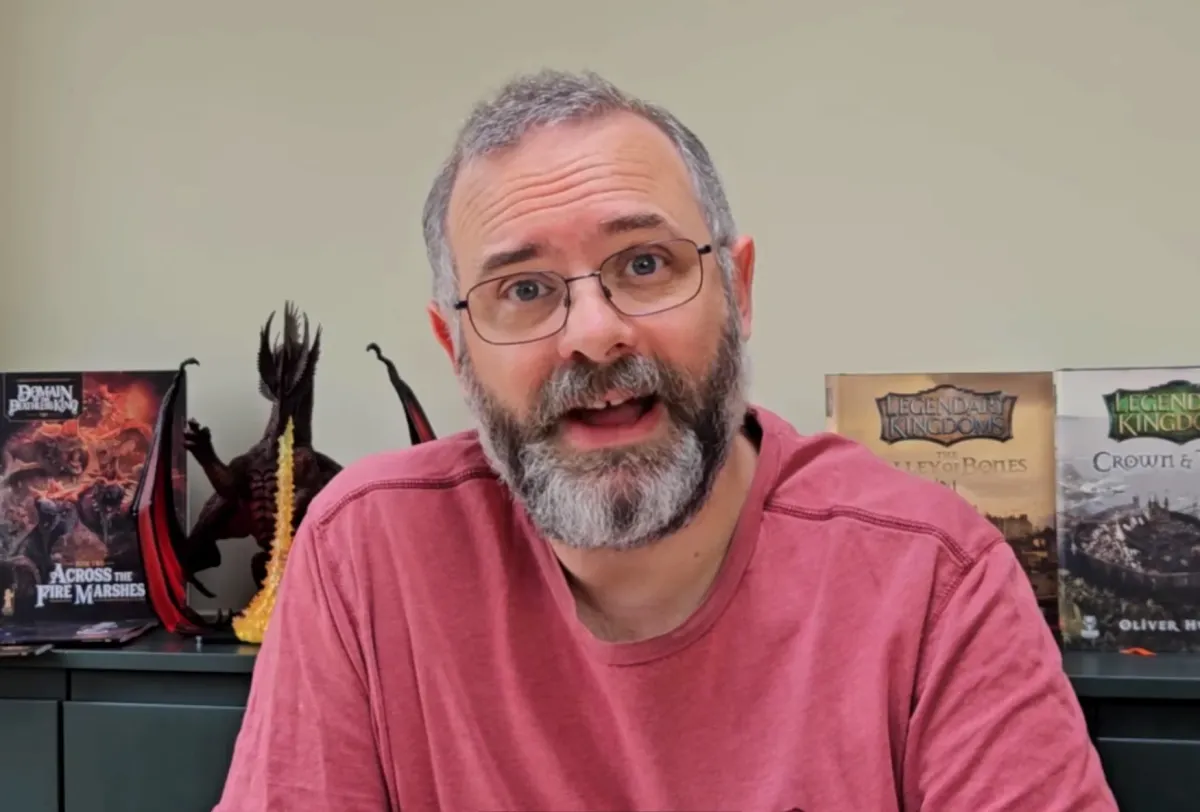
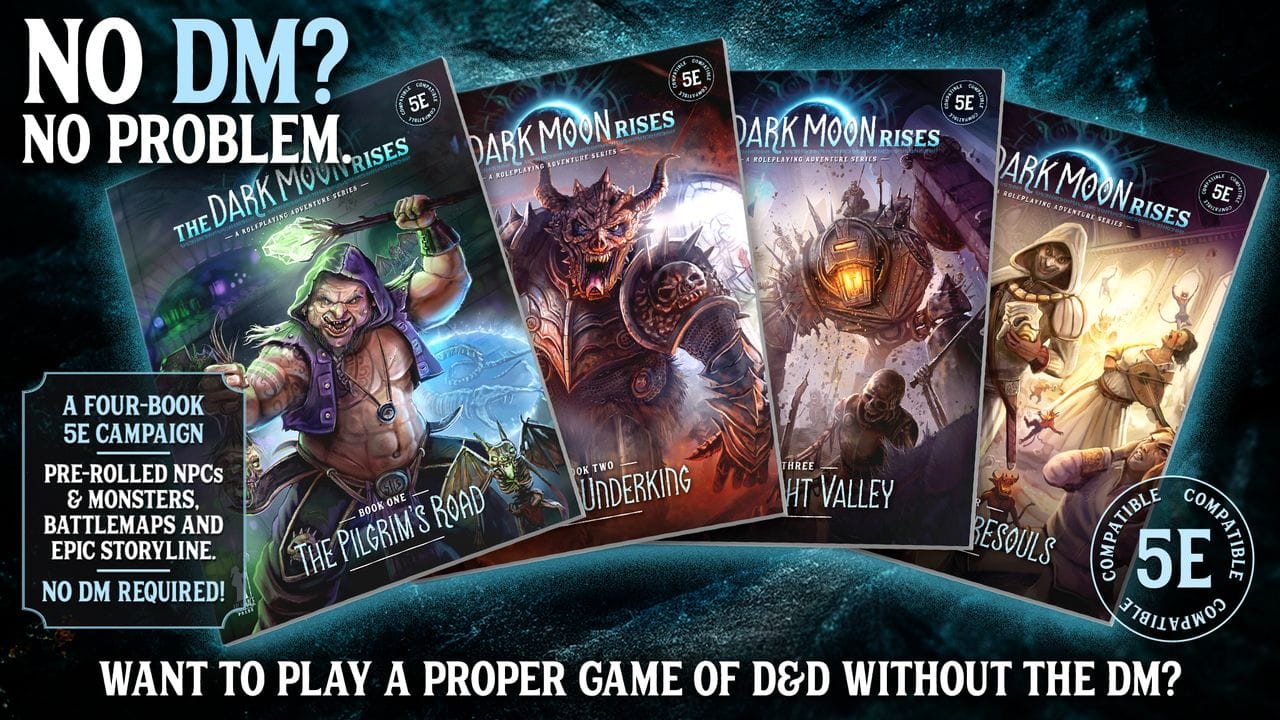
For most of us, “no DM” still sounds like a contradiction — like ordering a symphony without a conductor and hoping the brass won’t revolt. And yet Archmage Press has turned that contradiction into a product category: DM-Less 5E campaigns that play like “proper D&D” at the table, just with the referee role quietly redistributed across the rules, the book, and the players themselves. On their own site they frame it bluntly: full character sheets and dice, the only person missing is the Dungeon Master — and the numbers suggest this isn’t a niche experiment anymore.
In this interview, I’m talking with Oliver about how you design agency when the adventure is, by definition, “on rails” — and how you keep it feeling like an RPG session rather than a clever gamebook with extra steps. We dig into the craft problems that DM-Less forces you to solve in public: preventing “obviously best” choices, sustaining momentum when nobody is improvising behind the screen, and balancing tactical D&D against narrative flexibility.
But there’s also a more human origin story underneath the mechanics: years of wanting to play and not being able to find a table, plus the old Red Box solo DNA — that specific ache of having the rules, the imagination, and the craving… but not the group. DM-Less, in Oliver’s telling, isn’t market research pretending to be design. It’s an answer to a very common, very quiet problem in the hobby: sometimes the hardest monster to defeat is scheduling.
Onwards!
The DM-Less mechanic has become your calling card. Was the conviction that the market was ready for D&D without a Dungeon Master rooted in data, or was it a purely creative instinct?
The inspiration for DM-Less didn’t come from actual research, goodness, no. I think two things happened in my life that led me to it. Firstly, there was a period when I wasn’t able to play RPG’s for a good five years. I’d split up with my girlfriend and was living back with my parents, and the local gaming group only played Magic the Gathering. I longed to play D&D, but I couldn’t. After that, I moved to a place where I was able to game all the time, and that felt like heaven. But I never forgot the feeling I had in those lonely years, and figured that lots of other people would have been in my same situation.
The second, was a love of gamebooks generally, but of my first experience with the D&D Red Box all those years ago in particular. There were two solo adventures in it, which involved mapping, fighting monsters, recording treasure and going shopping. Absolutely loved it, but was frustrated that I couldn’t play an entire campaign that way. Now, of course, I can.
When designing an adventure for 1–4 players without a DM, how do you solve the problem of narrative flexibility? Where exactly does the line fall between a gamebook and a proper RPG session?
I try to imagine all the different choices that I would actually want to make in any given scenario, and offer those as solutions. I try not to include ‘duff’ suggestions that seem out of place. For example, if you were in a crypt, with dead bodies on stone slabs, and a pile of treasure at the back, I’d offer solutions such as sneaking, checking for traps and pre-emptive attacks. I wouldn’t include options such as poking the dead bodies, or striking up a chat with the treasure. Obviously, these latter ideas are things you can do in an RPG session, but most people will play it straight. As long as you include good, sensible options, people don’t seem to worry too much about not having every possibility available. I make it sound quite simple, but you’d be surprised at the number of gamebook authors who fall afoul of always presenting a clearly ‘best’ option, which robs the player of choice.
But let’s not hide from it. The DM-Less gamebooks are ‘on-rails’ adventures. I just try to make them as exciting as I can, and when the time comes to make a choice, most of the options look likely and useful.
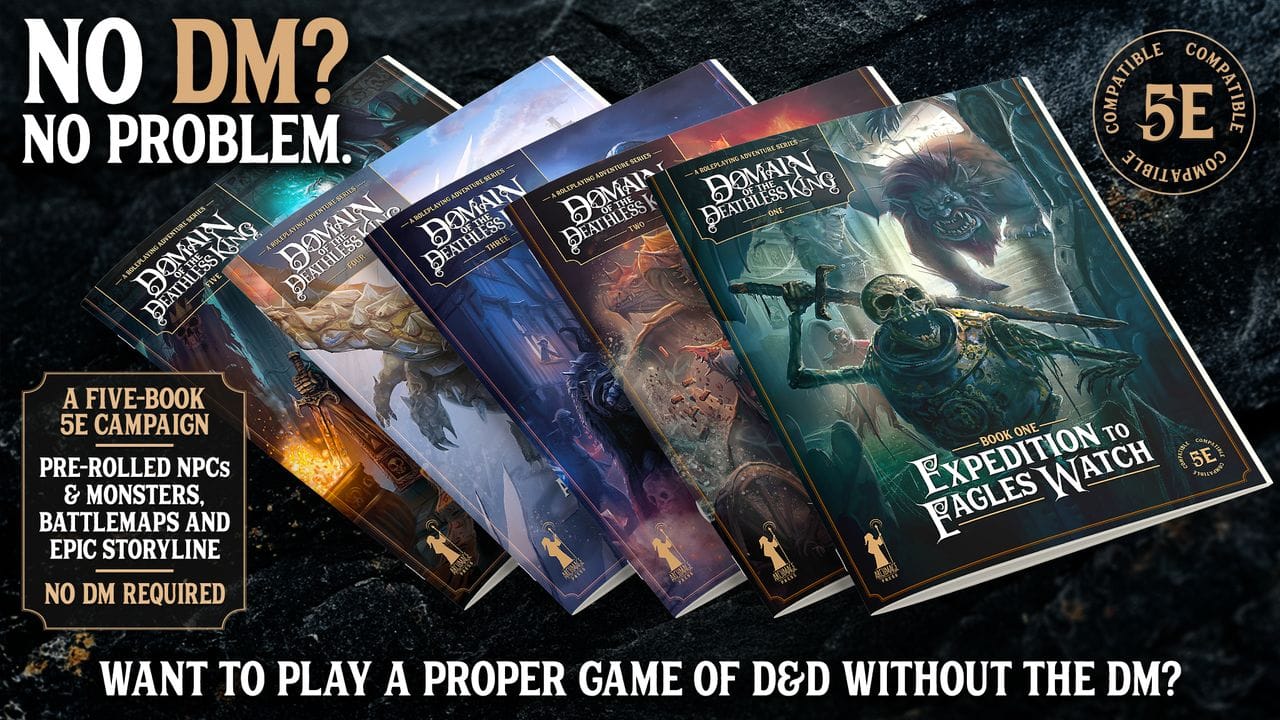
Oliver, you spent years as the Dungeon Master in your own campaigns. How did that experience help you write a system that replaces the DM entirely – and what surprised you most in the process?
What surprised me the most was that it was enormously difficult, and there are plenty of game systems I developed to go DM-Less that just didn’t work at all. Almost nothing works, because it’s so hard to make D&D fly without the DM there providing the passion, energy and ruling. Where experience as a DM helped was in providing the kind of plotlines that players most like to engage with. Domain of the Deathless King is an absolute classic of the genre, because you are going from 1st level adventurers with two days of rations and almost no equipment, to facing off against a lich on his throne loaded down with magical powers and abilities. It’s the campaign of player’s dreams – a simple threat, a mighty journey, tons of magic and monsters and plenty of heroic battles. Although every DM likes to produce a thought-provoking Magnum Opus, honestly, just give your players a bad-guy to slay, and a Lord of the Rings style journey of growth to go on and they are golden.
The Dark Moon Rises (and Legendary Kingdoms) are much more mature, but even they are ultimately action adventure games. You need things to happen and happen often in a DM-Less system, or people will quickly lose track and impetus.
Legendary Kingdoms, Domain of the Deathless King, The Dark Moon Rises, and now Sunfall inspired by Aztec mythology – your catalogue is remarkably varied. Is there a strategy behind choosing your themes, or do you simply follow what genuinely fascinates you?
So, Sunfall is not actually mine, but a very talented author’s called Michael Ward. He was published the old fashioned way, and therefore has maximum respect. (It’s also intimidating how much he knows about Aztec and Mayan culture).
In terms of our releases, we wanted two D&D-themed adventures right out of the gate in order to build up our library. We figured that most people will spend a couple of years going through those two campaigns first, allowing us to branch out in different directions and then come back to releasing new campaigns later. We didn’t want to saturate the market – but at the same time, I needed a full year to finish off Legendary Kingdoms, which honestly I see as my most important legacy to the gamebook genre.
Sunfall came about so that we had something to release during the ‘fallow’ year when I was writing LK. It’s a huge deal for us that we got Michael, because his success in conventional publishing was the thing that showed me that gamebooks could be a ‘thing’ again. We asked him what he wanted to do, and Sunfall just emerged almost whole from him. I think it’s a story he’s wanted to tell for a long time.
So I wouldn’t say we don’t have a strategy, but my feeling is you have to keep things broad. The Fighting Fantasy series was famous not only for its sword and sorcery adventures, but for its sci-fi, post-apocalyptic and superhero adventures too.
Releasing a product compatible with both the 2014 and 2024 editions of D&D 5e is no small feat. What design compromises did you have to make, and do you intend to stay within OGL-compatible systems going forward?
Honestly, from a DM viewpoint, those two systems are more similar that you might think. Obviously, low-level characters are much stronger in 2024. However, by later levels, things tend to even-out, which might sound strange. The fact is, a D&D turn is limited by its action economy (you can only do an action, move and bonus action in your turn). There is no doubt that 2024 characters have more actions to choose from, but most battles last an estimated four rounds, and by the time you are in the higher levels you just don’t have the opportunity to use them all. For example, in 2024 you can drink a healing potion as a bonus action, and in 2014 it requires a full action. But in the later edition there are a lot of very tempting options for a character’s bonus action, and restoring 2d4+2 hit points just isn’t very often an impactful use for it.
You do find the odd discrepancy. Chill Touch was changed from a ranged spell in 2014 to a touch spell in 2024. This had the odd result of the Deathless King being suddenly unable to attack characters at range when he had run out of spell levels. But honestly, if you’ve managed to weather all the spell slots of a 20th level lich wizard, you’re probably on the verge of winning anyway. Still – something for the reprints when we next look at it, I suspect.
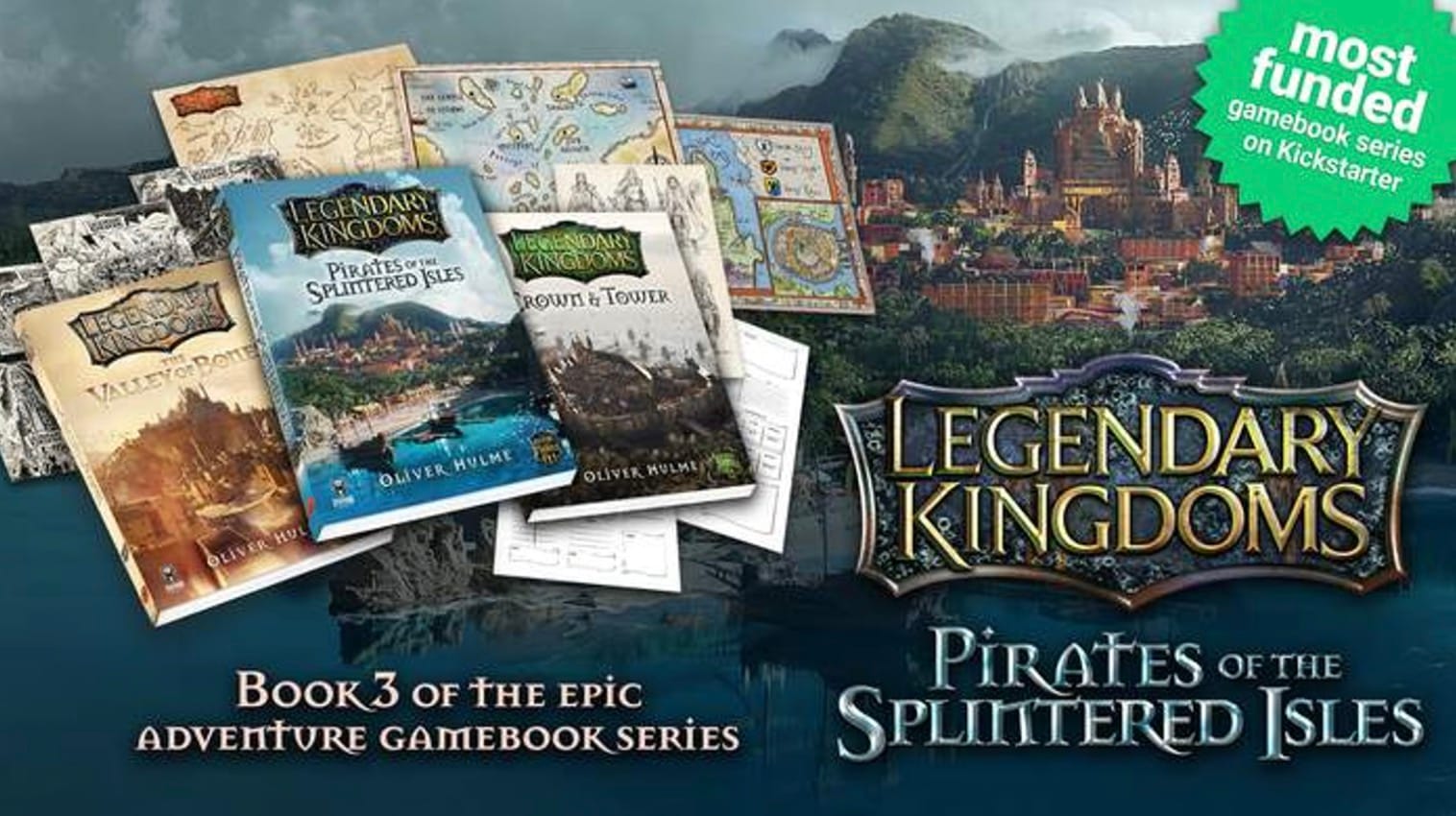
You acquired the Legendary Kingdoms IP from Spidermind Games at a moment when the community was frustrated by delays and poor communication. How did you go about rebuilding that trust – what worked, and what didn't?
It was a dreadful time. Spidermind was making dice for a hugely successful Kickstarter, and the factory in China produced thousands of duds which were unsellable. We were supposed to be insured against the loss, but the company we signed on with didn’t honour its pledges and Spidermind ran out of money. There is still a Spidermind Games, but it’s now run by a different group and I’m no longer a director.
I was taken under the wing of the wonderful Mel Byford, who owns Archmage Press. She wanted me to write books for her, and that is how Domain of the Deathless King came about. But she was also an enormous Legendary Kingdoms fan and wanted to see it brought back to life. She literally spent tens of thousands of pounds of her own money to get the books printed and to post them out to everyone. Mel is not, incidentally, a millionaire. She was a primary school teacher. That’s thousands of pounds of her own savings just to save the project.
Mel is an amazing communicator, and I think she soothed everyone’s spirits by delivering everything she could and being constantly honest. She didn’t have to do any of it … but Legendary Kingdoms does create a strong passion in people, and I think she couldn’t bear to see it turn to dust. Those who backed the LK campaign for the third book are going to get the PDF version of Book 4 for free as compensation for time they had to wait, and for some of the missing materials such as spell cards and journals that were promised. It’s not perfect, but it shows a willingness on our part to make things as good as possible.
Your community can raise £142K against a £5K goal – that's 2,857% funded. What's the secret behind that kind of loyalty? Is it the product, the communication, or something harder to put your finger on?
There is a gap, I think, in the market for really good D&D stuff that’s practical and useful. Finding ways to communicate what DDK (Domain of the Deathless King) and DMR (The Dark Moon Rises) are was the most complicated part. We actually avoided calling it a gamebook, because that suggests, in most people’s minds, pure solo roleplaying. But I knew that most people would play it in groups, just as some people ended up doing with Legendary Kingdoms. There was no expressed hunger for a DM-Less system because it seems so counterintuitive. But once people saw it, it gave forever DM’s the chance to play as equals with their players.
There are so many uses for it. You can use it as a system for testing character builds in ‘real world’ environments, as the books are constantly changing the types of challenges you face. It can be used by new DM’s who are nervous about DMing, who act as a referee for the rules, knowing that the story, monsters and challenges will keep coming just by reading aloud. Families love it, because they can play at times convenient to them, and you can play alongside mum and dad without feeling you have to compete with them. It’s very popular online, and I followed a Twitch group who played every week for a full year, including two resets after their parties were killed. It’s a challenge. It’s a gauntlet. But it’s also casual, and it’s all the author’s fault when things go wrong and everyone ends up dying. But when you win … I’ve never seen such jubilation.
Many TTRPG publishers build their communities through Discord, Patreon, or regular actual-play content on YouTube. Which channels have genuinely moved the needle for you, and which turned out to be a waste of time?
I’m a horror and a freak; I don’t use social media at all!
I wouldn’t recommend it as a strategy! My poor producer and director tear their hair out at my intransigence. It’s not an ego thing, I just don’t enjoy talking to people I can’t see. I keep waiting for it to fall out of fashion, but I suspect it will outlive me by some margin.
Our secret is strong design and good marketing. I’d like to think that some of it is also down to the writing, but, of course, you don’t discover the quality of that until you’ve bought the product. Good writing and good products are ‘hygiene’ factors in advertising (they extend the health of your brand) but they mean nothing to first time buyers. Selling is clinical and expensive. We market well, and our designer is excellent, as are our cover artists (the fantastic Jamie Noble, and the justly famous Claudio Pillia who was the background artist on Game of Thrones).
The first bite is delicious, and if people like it, they come back for more. But I won’t pretend there is anything magical about it. Fortunes are spent to bring this stuff to people’s attentions. If they decline … no more Archmage.
Reviews of your products are strikingly emotional – "it brought me closer to my girlfriend", "a lifesaver". Do you deliberately design your products to generate that kind of personal experience, or is it a happy side effect of good design?
I didn’t really appreciate that this was a thing until I followed that Twitch game. There was a guy on there who, like me, followed every week, and the hosts one day invited him to one of their games. He told them that he would love to … but he suffered from crippling social anxiety. Talking to people was painful and playing with them too awful to contemplate. This is a D&D fan we are talking about. He said that DDK was wonderful, because he could at last play the game he always wanted to, in a form as close to a live game as was possible. And I just thought … yeah, it was all worth it.
There has been feedback from Legendary Kingdoms where people have expressed delight that it was possible to have a same-sex relationship. It hadn’t even occurred to me that mine were the first gamebooks to do that. And, I mean, those are tough books. DDK is just an adventure game, but LK is full of difficult themes – race, class, assault, slavery, family breakdown – the whole shebang. Their success, I suspect, comes from the fact that I’m not a sensational writer (that is, I rarely write to produce a direct emotional effect), but I am an honest and sensitive one. I’ve always felt that as human beings we a principally emotional creatures, and that our logic follows on from feeling rather than detachment. The characters and things that happen in my books don’t come from a nebulous sense of plot, but also from emotion. The Deathless King did not begin a monster, and people still live who remember him as a good man. The Puresouls in The Dark Moon Rises genuinely think they are doing good, rather than evil, because it is too difficult to face the idea that they have become bad people. It’s nothing very complicated, but I think people pick up on these things and it makes their adventures feel richer and more real.
The Legendary Kingdoms Companion App – how did you arrive at the decision to extend the product into a mobile app, and how much did community feedback shape that direction?
This is entirely fan-work. They asked if they could, and we said ‘yes please’! Good, isn’t it?
You've run several campaigns, including ones that started at a £5K goal and ended in the hundreds of thousands. What has changed between your first campaign and your most recent – in terms of structure, messaging, and timing?
Ohh! These are big production secrets, and not something a mere writer spends much time thinking about. Let’s be real, we’re not enormous players, here. There are campaigns that make millions of dollars, and that’s not us. What we do have is good after-sales, so people keep discovering our stuff and buying it. (Thanks, by the way.) However, we do have campaigns that work at a scale we can comfortably keep up with, which allows us to be able to post out the goods ourselves everywhere except America (we have a special warehouse and fulfilment centre to do that for us, because America is very far away and has very special rules to follow when it comes to post).
We’re experimenting with shorter lead-times at the moment (we’ll see how that does with Sunfall), because we felt we sort of over-spent in the first two projects, and a lot of that initial interest vanished when people had to wait so long to pledge. So, we’re shifting that initial spend to the main body of the campaign rather than in pre-launch.
Goodness, this stuff is dull! Does anyone enjoy reading about campaign messaging?
The first 48 hours of a Kickstarter campaign are widely considered make-or-break. How do you prepare for that moment – how far in advance do you build your mailing list, and what exactly do you send out?
Hmm … I’m afraid this is where my expertise sort of sputters out. I mostly just write the stuff!
As a general rule, our pre-launch offerings are a video to generate excitement, and a free sample so people can play the first part of the adventure for nothing. I think it’s quite fair, because then you know what you’re getting is more than just hype. It’s expensive, of course, but that’s Kickstarter these days.
What's your relationship with stretch goals? Do you treat them as a marketing tool, a genuine commitment to your backers, or a trap that's easy to fall into if you're not careful?
Not a fan of them, personally. We decided not to use them for the first two campaigns, and instead just be honest about what we were offering. I see the idea of stretch goals. In the old days, when all you did was launch with a video and a dream, it allowed you to update a really successful Kickstarter with exciting new offers. No one who uses Kickstarter these days doesn’t plan to the Nth degree what they are offering months in advance. But I say, if something is available for sale, just sell it. Don’t pretend it magically appeared.
(In fairness, I remember with Spidermind Games, when we produced the Level Up, lots of people asked for a ‘middle tile’ in our portable gaming table, so they could make the table as large as they wished. It was a genuinely good idea, and we adopted it mid campaign as a stretch goal. So there you go, maybe things aren’t as black and white as I make out!)
Kickstarter gives backers a sense of co-creating the project. How do you draw the line between listening to your community and protecting your own vision – particularly when comments pull in different directions?
Well, I think with Archmage Press, our products are largely pre-written before we go to launch. We use Kickstarter to generate initial interest and to allow us to print copy.
Ironically, it’s after the launch that feedback is most useful. We try, when possible, to send out our PDF’s a few weeks early, before they go to print. We have a number of loyal fans who help us find errors to correct before the finals get sent off. So, we definitely get good feedback when we need it, and it is our backers who do it. It’s just that it doesn't really happen during the campaign itself.
How do you maintain backer engagement between campaigns, when there's no active project on Kickstarter? Do you have a deliberate "quiet period" strategy, or does momentum simply carry through?
We honestly try not to be too much of a bother. We keep people up to date with production goals (printing, writing completion, PDF delivery, etc), but we try to keep things professional. I know we advertise to get interest, but we sort of give people a break from it when we don’t have something to sell.
As a counterbalance, we try to have something new every year for people to buy. We want people to have good experiences with us, and not to feel that we’re constantly yelling at them. Because after-sales are so good, we’re relaxed about people spending their money when it’s comfortable for them. But we’re not so relaxed that we wouldn’t advertise at all!
The market is being flooded with TTRPG products generated with the help of AI – artwork, writing, even entire game systems. As a publisher built on deeply human design and storytelling, how do you look at that shift?
If AI makes better or more useful things than I can make, then people should use that. It’s not that I’m not worried, but just very realistic. At the moment, AI writes better than most people, but its style is predictable, which rapidly becomes dull. It may stay that way, in which case those who write as a form of art will still have room to breathe. Or it may get better and better, discovering whimsical turns of phrase, and surprising – and unconventional – structures that attract the eye and keep people reading.
Who knows? It’s bigger than me, and I’ll try and live in the world that is created from it. I’ll also try not to be bitter if it turns out to be better than me.
Do you use AI at any stage of your production process – from playtesting and editing through to marketing – and if so, how do you communicate that (or not) to your backers?
I was going to say ‘no’, but actually, our new video for Sunfall is animated through AI. All the art is hand drawn, but it’s been animated in a sort of … how do you describe it? It’s like when you draw a person, and their limbs are stuck on with split pins, and you can move the limbs about individually.
What the AI has done is take the characters, infer the background behind them, and then has them moving around in a kind of 1970’s children’s TV animation – only with grizzly monsters.
It’s actually not what we commissioned, or envisioned originally. I was thinking of lots of long shots of the book, dramatic music, pages turning, false fire and blood effects, etc. But Bruce Kenedy, our designer, got a bit carried away, and made it a fully animated work. I remain unsure, but if I’m totally honest, all the fire effects and blood splashes … even the pages turning … were going to be computer generated effects anyway. The art hasn’t been stolen, it’s all stuff commissioned and paid for. And yet … and yet…
I remember when I was working on the Elite Dangerous Roleplaying Game, we had about two hundred art pieces commissioned. Around each image was a little designed border created by Bruce … but in one piece, the artist had drawn the head too close to the top of the picture, and it kept getting cut off. Now, this was a mistake, because the artist knew we needed space around the outside to frame the image. But, you know, he drew two hundred of them, and we are but human. It was 2015, and I watched as Bruce took a sample of the sky, and used a tech-widget to extend the sky above the character’s head. He explained the widget was designed to infer the pattern of backgrounds, and to logically expand it. He did it in front of my eyes, and I was astonished. It was proto-AI, and I remember laughing that it was a shame it couldn’t generate the whole image and save us a bunch of money. I’m not sure I’m laughing now…
Kirk Wiebe of PhD20 said in his RPGdrop interview that AI can support GMs but will never replace human imagination at the table. You've created a system that replaces the DM through mechanics – do you see AI as a natural next step in that direction, or is it a fundamentally different thing altogether?
At the moment, Kirk is right. AI loses the plot, has no creative drive, no hunger, no desire to impress. It’s not flirting with attractive people around the table, it’s not trying to compete with its friend who seems to know the game rules better, it’s not trembling that it is being too harsh, worried that its players ‘aren’t digging it’ or that the dice are being too arbitrary. It has no skin in the game.
The secret truth about DDK is not that it really has no DM, or that the DM has been replaced by a series of mechanics. The truth is that the players have become the DM. They are interpreting the rules with mechanical guidance, because they are perfectly capable of doing it themselves.
D&D has a spell called charm person, which makes an enemy a friend. There is not a single rule in my books that tell you how to administrate that, and there doesn’t need to be. Read the spell description and decide for yourself. Does that orc you charmed stay with the party after the battle? Up to you. Does it leave peacefully and return to its tribe? Up to you. Does it turn on you as soon as the battle is over? Not in the rules, but up to you. No game of DDK has ever fallen apart because I didn’t tell the player what to do. They just do it. What on earth can AI do to improve upon that?
However, there is always a chance that instead of ‘peaking’ AI just gets better and better, eventually exceeding human capability. When that happens, D&D with people will only be played by real ale drinkers, wargamers, stamp collectors, heavy metal enthusiasts and those who dig improv theatre. Basically, the same audience it started with.
Are there specific parts of gamebook creation where AI could be genuinely useful – generating combat variants, balancing encounters, producing maps – and where would its use be a mistake in your view?
I’m sure it could. But I also write for pleasure, not merely for function. It’s fun to design all those things yourself, and it creates a coherence that AI currently struggles with. The way the maps work at the moment, is that I draw a crap black and white version on a grid, and send it to talented artist who lives in Puerto Rico. He makes his living drawing maps, and he’s very good at it. I don’t think he uses AI because the errors he makes are rather human (whoops, forgot to put in that pillar, as opposed to whoops, that pillar has six fingers and stops existing when it passes behind a barrel), and he can change minute details of lighting without otherwise altering the image.
Imagine Archmage Press five years from now. Is it a publisher that makes full use of AI tools whilst maintaining quality, or does it deliberately stay “handcrafted” as a point of distinction in a sea of AI-generated content?
Gosh! Another AI question! I suppose it is the thing…
I suspect that one of two things will happen. 1) The AI bubble bursts, the main AI tools go down because they are now too expensive to maintain, and AI shrinks to a tech that is used for data crunching in specific job areas. 2) AI become omnipresent to the extent that nothing can be created without it anymore. In other words, you can’t get a video editor that just applies visual effects; the only video editors around use AI to achieve those visual effects – and it doesn’t ask your permission to do so. Slowly, digital art tools become so filled with AI that it is no longer possible to create an image without it. How we read becomes so influenced by AI style, that individual human styles become slowly less and less legible to the common eye. Every film, book, advert, product and form of visual stimulation or education is powered by AI so fundamentally, that it is impossible to separate the old from the new.
In such a world, Archmage Press would use AI because it is no longer possible not to. Also, because in this world our artists and map creators are using ‘updated’ software that contains it, and they don’t know if it is ‘AI’ changing the colours on an image, or an old piece of code from the pre-AI era.
A final point on it, and that will probably be enough. One of our artists, Jamie Noble, is very distrustful of AI. But I remember watching him work on a character design, live on screen, a few years ago. He drew a serpent woman, but she was a bit too generous about the waist to look like a snake. Rather than redraw, I saw him ‘tuck in’ the waist of that serpent woman with a graphics tool in under three seconds. It wasn’t AI doing this, but let’s face it – you can’t do that with a crayon.